12 Eylül 2026
açık


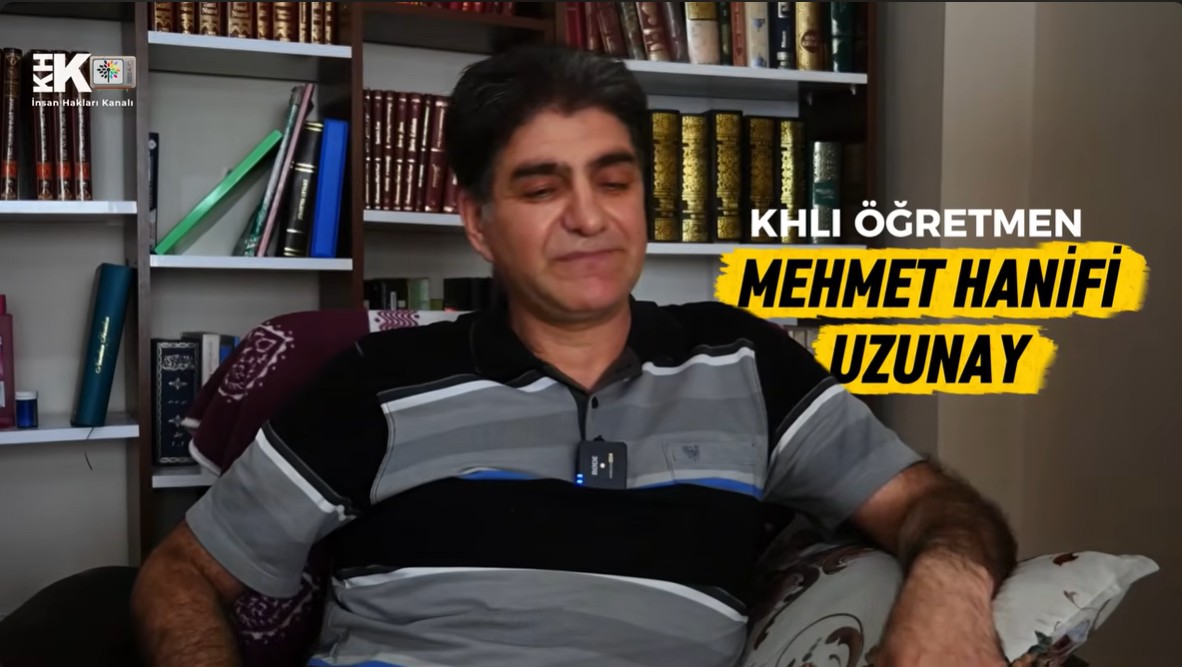
Journalist Ahmet Erkan has brought public attention to the extraordinary life story of English teacher Mehmet Hanifi Uzunay in what he describes as one of the most significant interviews of his career. The interview chronicles Uzunay’s years-long struggle following his dismissal under a Statutory Decree (KHK) in the aftermath of Turkey’s post-coup purge process.
Introducing the interview, Erkan described it as “the most tragic story” he has ever documented, stating that the events recounted by Uzunay are dramatic enough to resemble the plot of a feature film. The interview covers a wide range of experiences, from prison years and severe health problems to family tragedies and a life-threatening struggle at the Greek border.
Mehmet Hanifi Uzunay, who worked for many years as an English teacher within Turkey’s Ministry of National Education and abroad, was dismissed from public service under a Statutory Decree (KHK) and subsequently imprisoned.
According to his testimony, he endured extremely harsh prison conditions. Uzunay alleged that he spent extended periods in cells where lights remained on continuously, hygiene conditions were inadequate, and sewage water frequently flooded the area. He stated that these conditions led to serious health complications.
Uzunay further claimed that he lost a significant portion of his eyesight due to severe damage to his corneas and that he was unable to access adequate medical treatment for an extended period.
One of the most emotional aspects of the interview concerned Uzunay’s separation from his family.
He stated that no relatives visited him for nearly four years and described the inability to receive news from his children as more painful than the prison conditions themselves. Recalling the first time he saw his children after years of separation, Uzunay became emotional and said he was unable to speak because of the overwhelming impact of the reunion.
Another striking section of the interview focuses on Uzunay’s attempt to leave Turkey.
According to his account, he was apprehended while trying to cross into Greece, subjected to mistreatment, and later abandoned at sea. He described the experience as a struggle between life and death, saying he spent days battling hunger, cold, and fear.
Uzunay also spoke about the situation he encountered after his release from prison.
He said that his family had fallen apart, his mother had passed away, and his children had suffered severe psychological trauma. In particular, he claimed that his daughter attempted suicide three times, emphasizing that the consequences of his imprisonment affected not only himself but his entire family.
Throughout the interview, Uzunay frequently referred to the lives of the Prophets Joseph and Job, drawing parallels between their hardships and his own experiences.
He stated that faith was the force that kept him alive during years of loneliness, illness, uncertainty, and suffering. According to Uzunay, spiritual resilience enabled him to survive circumstances that at times seemed unbearable.
The interview conducted by Ahmet Erkan presents not only a prison narrative but also a story of perseverance, family bonds, faith, and an individual’s struggle to rebuild a life after years of hardship.
The Ottomans had a saying that I deeply cherish: “He who has not tasted grief, knows no sorrow; yet he who has not tasted grief, truly lives.” Indeed, those who haven’t experienced it cannot possibly understand; some things simply defy words. Even if you were to turn my life into a movie, no actor could ever do justice to the role. It can only be truly grasped by someone who has lived through it.
While I was in prison, as my release date approached, I actually began to dread leaving. While everyone else was praying to escape that place, believe me, I was begging, “My God, do not let me out of here.” Why? Because while everyone else was sent off with applause and joy, I had absolutely nowhere to go on the outside. I had no idea where to turn. Many of my inmates would sit down and weep for my sheer helplessness.
Yet, in the past, I had spent seven years in Çanakkale working as a completely voluntary guide, never asking for a single penny. When I walked down the streets of Denizli, people would stand up out of respect and offer me a seat, saying, “Here comes the Çanakkale teacher.” In fact, the mayor at the time respected me so much that he once told me, “Teacher, give us two names, and we will name streets after them.” Look how far I had fallen…
When I was transferred to the Erzurum Oltu T-Type Prison, they didn’t put me in a regular ward right away. I was transported in handcuffs. In the freezing cold of February 15th, through treacherous mountain roads, they wouldn’t even let me use the restroom. Terrible, unspeakable things happened. When we finally arrived at the prison, I thanked God, thinking that at least I wouldn’t freeze to death. Since my clothes were soiled, I wanted to change into clean garments so I could perform my prayers. Instead, they just told me to “Wait” and locked me away in an isolation cell.
Where they took me was not a proper cell; it was a filthy, disgusting place, like a boiler room, with water constantly leaking from the ceiling and sewage overflowing from the toilet. The bunk bed was bolted to the floor, and right above me was a massive light controlled from the outside that was never turned off. I would toss and turn, trying desperately to cover my eyes, but it was useless. I couldn’t tell day from night. I became gravely ill in that cell. The entire right side of my body swelled up, and antibiotics did nothing to help.
Sewage water was rising from the floor. When I begged the guards to turn off the light, they told me it was legally forbidden. It felt as though they wanted me to commit suicide. I stayed there for about three months. I later learned that they put people there to break them completely—mind and body. Before me, a colonel who had been kept in that cell lost his mind and stripped completely naked; I don’t know where they took him after that. Hearing that a few others had passed away in that very cell, I fell into utter despair.
Even though there was no physical torture, the constant radiation from that ever-burning light and the electrical hum was destroying me. From constantly rubbing my eyes, my corneas fractured; my head was spinning constantly. My gums were so swollen with infection that I resorted to using a needle to pop the abscesses myself, thinking, “We are definitely going to die in here.”
Because my cognitive functions were grinding to a halt, I could no longer read books. My only refuge was prayer. I would read the Qur’an, but I couldn’t find peace. Finally, I remembered a passage from a book I had read about “how those in dire straits should call upon Al-Khidr (the Green Man).” I knew the necessary prayers and surahs by heart. I closed my eyes and tried. I thought to myself, “If Khidr is to come to the aid of the desperate, let him come, but this place is filthy, and they won’t let me clean it.” Nothing happened during my first two attempts, and I began to lose hope. On the third try, Al-Khidr did not come, but in the realm of dreams, the Great Master (Bediuzzaman Said Nursi) graced me with his presence.
At that moment, I was in a state of sheer shock. I had previously heard a story about a man who had a car accident in Bergama, who claimed, “Al-Khidr came to me in the likeness of a certain brother.” This meant Al-Khidr could appear in different forms. In my dream, the Master said to me, “Recite Surat Al-Falaq 1001 times and Surat An-Nas once every day, and research how I overcame these hardships.”
We knew from history that the Master had been poisoned dozens of times, yet he survived every single time. While researching how he managed this, I discovered four verses of healing in the Holy Qur’an:
The date was March 6, 2018. When I began reciting these prayers, it felt as though the world became mine. Books often mentioned that the malicious force known as the “Sufyan” was actually miserable and pathetic, drawing its power solely from illusion and spiritual manipulation. The Master had essentially given me the cipher to break this malice.
I recited them uninterrupted for a week. Like an innocent child, I vomited out all the toxicity built up inside me and found relief. The severe illness that had forced my eyes shut and swollen my lips subsided by thirty percent. Believing I had found the solution, I clung to the prayers. However, thinking I was completely cured, I stopped reciting them after fifteen days. That night, I received a spiritual slap in my dream, which left a physical mark on my face. I realized then that this was not a battle to be won in just a couple of tries.
While researching how the Master resisted the poisonings, I came across this quote of his: “Despite the immense amount of poison given to me, the Jawshan and the Evrad-i Kudsiye prevailed.” Upon finding this, I began reciting the Jawshan and the Evrad-i Kudsiye. I would repeat the disconnected letters (Muqatta’at) in the Evrad-i Kudsiye 7, 21, 63, or 99 times, depending on the situation. In the beginning, these repetitions would take until evening, but over time, I memorized them all. I have never stopped reciting them to this day. By God’s grace, all my afflictions vanished, and I came back to life. My cellmates would say, “Brother, people age when they come to prison, but you look younger with every passing day.” Of course, I never shared these spiritual experiences with anyone.
When the prison administration realized I wasn’t going to die in that isolation cell, the director finally came and said, “Teacher, let’s move you to a regular ward.” In the ward they took me to, there were wonderful, bright-hearted people. They had spread blankets over the concrete floors. Seeing that environment brought me immense joy; I gave thanks and continued my prayers.
However, during that period, absolutely no one came to visit me for four long years. My daughter was 13, and my son was 12. Where were my children? What were they doing? Was their mother looking after them? No one brought me any news. Whenever the other inmates had visitors, my head would sink in sorrow. The guard constantly shouting down the corridor, “Mehmet Hanifi Uzunay, everyone else has a visitor, but you have none again,” created an indescribable gloom within me. It felt like imprisonment within imprisonment, a dungeon within a dungeon.
To keep from losing my mind, I increased my hours of dhikr (remembrance). If I slept for 6 hours a day, I spent the remaining 18 hours in dhikr. I could no longer read books because my corneas had fractured from constantly rubbing my eyes in that filthy isolation cell. When walking, I couldn’t keep a straight line and would sway from side to side. When I looked at people, everything blurred and shook, making me nauseous and dizzy. The glare of light became a form of torture. I suffered a 98% loss of vision in my right eye and a 40% loss in my left eye. The standard eye drops provided by the infirmary doctor only caused more damage. Despite writing dozens of petitions, they refused to refer me to an ophthalmologist.
After a year and a half, I was finally taken to a hospital. The young female doctor who examined me was stunned by my condition. Knowing that medical professors and associate professors were also imprisoned inside, I spoke to her using professional medical terminology based on the diagnoses they had informally given me. Surprised, the doctor snapped, “How do you know all this?” I replied, “There are many doctor friends inside; I learned it from them.” Hearing that doctors were imprisoned, she understood my situation instantly. “Forgive me, brother,” she said, before turning to the gendarmerie guards and ordering, “Uncuff the patient’s hands immediately!”
She sent the gendarmerie outside and asked, “Have you been assaulted? These fractures in the cornea are not natural.” I wrote petitions to be referred to the prosecutor’s office, but the prison administration kept destroying them. I fought for two years just to get hospital referrals. All the while, the yearning for my children burned deep inside me.
One night, I saw my son and daughter in a dream. When I woke up in the morning, I didn’t even want to get out of bed, but the room was filled with a magnificent fragrance. I had once read a Hadith stating that the scent of one’s child is a scent from Paradise. When my cellmates asked, “Brother, why aren’t you getting up?” I told them, “I will not get up, I can smell Prophet Joseph’s fragrance.” That day, aside from my routine prayers, I fasted from food and recited ten parts (juz) of the Qur’an just to hold onto that spiritual state. I believed that even if my children didn’t come, God had sent me their scent.
Right at that moment, the guard shouted down the corridor: “Mehmet Hanifi Uzunay, you have a visitor!” Hearing those words, my hands and feet began to tremble violently. Because no one ever came to see me, I hadn’t shaved in months; my hair and beard were completely overgrown, and I was wearing nothing but shorts and a sweatjacket. My cellmates immediately rushed to my side; one trimmed my beard, another found a proper pair of trousers and a shirt that fit me. Seeing my frantic state, the guard showed kindness and let me wait a moment. And so, for the first time in five or six years, I went to see my children.
It turned out that the wife of one of my cellmates had shown incredible loyalty on the outside; she had tracked down my children, bought their plane tickets, and brought them all the way to Erzurum. When I walked into the visitation booth, the other inmates had turned away from their own families, watching us with bated breath. I embraced my children, but my throat locked up completely. It felt as though thousands of hemp ropes were knotted from my stomach to my throat; I couldn’t make a sound. I drank water, splashed it on my face, and even pinched myself to snap out of it, but I couldn’t utter a single word. Despite the guard granting us extra time, my tongue remained tied. We simply held each other, wept, and breathed in each other’s scent. My daughter had grown into a young woman, and my son was now taller than me. Without even being able to ask, “How are you, where are you studying?” we parted ways without me speaking a single word.
Inside prison, people’s psyches are incredibly fragile. An inmate sleeping on the bunk below me lost his mind and was sent to psychiatry simply because his wife missed two consecutive weeks of visitation. Yet, I endured that absolute isolation for four straight years. I was a father who doted on his children. After they left, I fell into a severe crying fit in the ward; they couldn’t stop my trembling. At night, so as not to disturb my friends, I would stuff the corner of the pillow into my mouth, burying my screams inside me.
It took two or three days for me to recover. A friend brought some olive oil and soap and said, “Brother, there is hot water tomorrow, let me wash you.” Everyone in the ward took turns helping me bathe; they rejoiced with me simply because my children had visited.
Later on, I managed to get my daughter’s phone number, and we began speaking during the weekly allotted phone calls. I had ten siblings, but my mother used to always say, “My son, you are living the destiny of Prophet Joseph. From the slander of your relatives to the dungeons, everything mirrors his life.” And so it did; my life became a saga of exile and migration. I wasn’t even able to attend the funeral prayers of my mother, my father, or my siblings. They had hidden my mother’s passing from me while I was inside; I only learned about it much later.
While speaking to my daughter on the phone, she told me, “Dad, I am not living with mom. A journalist sister named Kezban took me in; she became my foster mother. My brother is staying at the dormitory of the maritime school.” It was at that moment I realized my family had completely fractured.
As my release day drew near, unlike everyone else, I didn’t want to leave. I had no home, no refuge left on the outside. On the day I stepped out, prison officials and security officers still wouldn’t leave me alone, trying to force me to become an informant by saying, “Give us names, cooperate, look at the miserable state you are in.” Unable to take it anymore, I snapped, “You want names? Our country is ruined, plundered, they have stolen the nation! Can you go and bring them down?” I took my ID and walked away.
When I stepped outside, I couldn’t walk properly; because of my fractured corneas, the ground and the sky blurred into one. My son appeared before me at the bus station, and we held each other, weeping for half an hour. Right then and there, I prostrated in a prayer of gratitude. My home was gone, and all my belongings in Izmir had been looted. Thankfully, two loyal cousins from Ağrı came and took me in, despite their own fears of association.
I had requested to transfer my parole signatures to Denizli because it was a city I knew well. I stayed at my brother’s house for a single night; however, his wife said, “This man is blind and disabled, he will be a burden on us,” making it clear I wasn’t welcome. My relatives, paralyzed by fear, had manufactured horrific slanders about me just to keep their distance. There were even those who came with the intent to kill me. I thought to myself, “The prison was safer than the outside world; what kind of ruthlessness is this?”
Taking nothing but my four sacred books and the Qur’an, I left that house. Saying, “Everyone has abandoned me, but these books have never left my side,” I began sleeping on the streets, in parks, and in mosque courtyards. Because I spoke English and Russian, I received lucrative job offers, but I refused to part with my books and my spiritual life. Armed with a dhikr counter on the streets, I would walk in circles just like I did in the prison yard, reciting Surat Al-Falaq and An-Nas 1001 times. I prayed, “My God, do not make me dependent on dishonorably cruel people; if You are to take my soul, take it among the pure-hearted.”
I learned that my daughter had won a seat at Akdeniz University’s Faculty of Communication, ranking second in the entire country. She told me, “I chose this department to defend your rights, Dad.” I went to Antalya to find her. The place she was staying at was a terrible, unhealthy environment for a young woman. I desperately needed to earn money and establish a proper life for my children.
Through an English teacher friend in Antalya, I started working on construction sites. However, I was physically spent; my head would spin, and I would vomit every few hours. When the contractor noticed my condition, he asked my friend what was wrong with me; to hide my prison record, my friend lied and said, “His wife recently passed away, his psychology is shattered.” The contractor came over, handed me two days’ worth of wages along with my bus fare, and said, “Teacher, go and get some rest, you cannot work in this state.” Having just been released from prison, I had forgotten how to handle money, how to shop, or how to spend it. Even the clothes on my back were my son’s old, outgrown garments.
I went to the house of Kezban, the woman who had taken my daughter in. She told me, “I have invested four years of effort into this child. While her own biological mother abandoned her, you are merely her genetic father; I will not give her back to you.” She had recognized my daughter’s intellect and taken her in, but the painful truth lay deeper: my daughter was so fiercely attached to me that when no one would tell her where I was while I was imprisoned, she spent a year and a half searching for my grave. Unable to bear the grief, she had attempted suicide three times. Furthermore, this woman was beating my daughter—who washed dishes until midnight—reproaching her by saying, “You can’t even earn enough to cover your mother’s makeup expenses.”
To make matters worse, the woman had brainwashed my daughter, trying to turn her against me by claiming I worked for Zionist interests and was a traitor to the country. Meanwhile, she whispered to my daughter, “Your father is very charismatic and a good man; convince him to marry me, we have a house, we can all live together.” During the four days I stayed in that house, I felt spiritually suffocated. I took refuge in the Jawshan and the Evrad-i Kudsiye. By the grace of those prayers, on the fourth day, the woman suddenly fell ill. She began to scream, “Mehmet Bey, stop reciting Al-Falaq and An-Nas, I beg of you, stop!” Eventually, she softened and said, “You are a very good man, take your daughter and go.”
I took my daughter with me, but once again, we had nowhere to sleep. We slept outside in parks. In the freezing cold of February and March, I would bathe in the sea just to keep clean so that my prayers wouldn’t be invalidated by filth. When I asked my son, “Who is left from our old, loyal friends in Izmir?” he gave me the name of an old companion. We called him, and the moment he heard my voice, he wept with joy and said, “Come to Izmir immediately.” My son booked our tickets through a phone app; I didn’t even know technology had advanced to the point where one could buy a ticket on a phone.
When I returned to Izmir, the city had changed completely. I slept on the streets for a few days. I owned nothing but a single pair of corduroy trousers from Ağrı and an old pair of sneakers. I would wash my underwear in mosque restrooms, wring it out, and put it back on wet so that I could pray in a clean state. My health was failing, but I fought to keep my faith alive.
When my friends finally found me, they burst into tears, and we immediately began searching for an apartment. The prison psychologist had told me that I had developed a phobia of the outside world. Just like in the movie The Shawshank Redemption, I was terrified of failing to adapt to freedom. My relatives and my tribe had turned against me; the outside world felt far more dangerous. I prayed for a home that would feel right—warm in the winter, cool in the summer, where I could read my books in peace.
Finally, we found a clean apartment with natural gas heating, exactly as I had envisioned. The landlord wanted 2,500 TL for rent and refused to budget. Just then, his daughter, who was attending a prep school, walked in. She looked at my face and exclaimed, “Dad, I know this teacher!” Because of my fractured corneas, I couldn’t make out her face immediately. When I asked which high school she graduated from, she replied, “Bornova Anadolu Imam Hatip High School.” It was the last school I had taught at before being wrongfully dismissed. “And who was your English teacher?” I asked. She said, “He was a wonderful teacher named Mehmet Hanifi.” Hearing this, her father cried out, “Teacher, please come inside, I know who you are.”
They welcomed me into their home, serving me meals. I felt so out of place stepping on a proper rug and being treated like a human being that I was overwhelmed with shame. In prison, they never gave us sweets; sometimes the conscript guards would melt sugar, spread it inside bread, and sneak it to us. When the landlord’s wife offered me poppy-seed pastry, I ate bashfully, trying hard not to look ravenous. She wanted to throw my single pair of trousers into the washing machine, but since I had no spare underwear or pants, I had to hide the truth and say, “No need, sister, thank you.” The landlord told me not to worry about the rent; they hooked up my gas, electricity, and water without asking for a dime. While my old world had collapsed, God was building me a new home through the hands of kind strangers. I wept uncontrollably.
After securing the apartment, a former inmate friend called me. He had crossed over to the other side and become an informant, but afterward, his child was born with Down syndrome and missing an arm. He told me, “I wish I had spent 10 years in prison if it meant my child would have been born healthy.” At that moment, I counted my blessings; thank God, my children were healthy. I let go of all my bitterness.
In Burhaniye, a wealthy woman had passed away, and no one wanted her furniture, believing that items belonging to the deceased brought bad luck. They loaded all those high-quality pieces onto a truck and brought them to my apartment. Total strangers came by to hang my curtains and clean the rooms. Within three days, I had a fully furnished home.
Then, my serious medical treatments began. Because I had used a needle to lance my gums in prison, severe damage had occurred in my jawbone and tooth roots. When the dentist took an X-ray, he was horrified; “Mehmet, how are you even functioning? Due to intense nervous pressure, your lower tooth roots have completely split in two,” he said. They extracted seven upper teeth and three lower ones. The oral surgeon remarked, “It is a miracle you survived with that level of pain.”
Once my parole period concluded entirely, the icy distance between my children and me began to thaw. My daughter was going through a severe psychological crisis; she didn’t step out of the house for an entire year. I guided her toward sports and took up working out myself. I began earning a living by teaching online English classes from home.
Because of my status as a dismissed public servant under the state of emergency (KHK), they had barred me from entering the organ transplant list at state hospitals. The private Dunyagoz Hospital was far too expensive. However, after I resolved a critical bureaucratic matter in just five days for a businessman to whom I taught Russian, he handed me 15,000 TL. I used this money as a deposit at the hospital. Hearing that I spent the money on medical treatment, the businessman was deeply moved and gave me an additional 10,000 TL. Around the time of the earthquake, a matching cornea became available, and I underwent a highly successful transplant surgery. My treatment is still ongoing, but I have finally begun to see again.
Believing that my life was no longer safe in Turkey, I had decided to flee abroad. Without telling my children, we set off to cross the Aegean Sea via Chios Island. However, we were intercepted by the Greek police on Chios. Four of our companions managed to flee, leaving me stranded with an elderly man who suffered from a heart condition. On a freezing, snowy night, they pushed us into the marshlands and opened fire over our heads. Relying on my past military training and knowledge of terrain, I found camouflage and kept moving until morning to avoid freezing to death. They deployed drones over us; to prevent thermal cameras from detecting the smoke, I wrapped a small fire in a wet towel to keep us warm. On the third day, we were captured.
The Greek police dragged us to a remote mountaintop and beat us savagely. The more I spoke English to explain that the old man was sick, the harder they hit us, shouting, “He speaks English, he must be a spy!” They broke my jaw and my nose. They cuffed our hands behind our backs, pulled two masks over our heads to suffocate us, and locked us away in a pitch-black basement for 13 hours.
In the dead of night, hearing the sound of breaking waves, I knew they were going to throw us into the sea. They forced us onto a speedboat, and in the middle of the open water, they pointed to a tiny, plastic circular float—what they call a “duck”—and ordered, “Jump!” When I resisted, saying, “This is suicide,” they struck us with rifle butts and threw us into the open sea.
It was early April, and the water was bone-chillingly cold. Waves tossed us meters into the air. The small float was constantly taking on water. I turned to the elderly man and said, “Haji uncle, we are going to die. Come, let us renew our faith before we pass, and pray our final prayer.” My arms could barely move because they were tightly wrapped in plastic film, but somehow we managed to pray. I remembered the words of Abdul Qadir Gilani: “Whoever is in dire straits and recites Al-Ikhlas 11 times and Al-Fatiha once for me, I shall grant them my spiritual aid.” I recited them, but nothing changed. I admonished myself, “You fool, God is right here!” and clutched onto the prayer of Prophet Jonah: “There is no deity except You; exalted are You. Indeed, I have been of the wrongdoers.”
I swear to you, not half an hour had passed before that tempestuous sea became as smooth as a sheet of glass. A profound tranquility and peace descended upon us. The moon was so close to the water that the sea shimmered like a silver platter. No photographer in the world could ever capture that sight.
At 03:10 AM, the Turkish Coast Guard spotted us and pulled us from the water. In the official logs, we were recorded as “two corpses pulled from the sea,” because we were on the verge of freezing to death. The soldiers wrapped us in blankets and treated us with great kindness. I rejoiced to be back in my homeland. However, in Çeşme, a civilian commander saw the baseless phrase “secret imam” on my file and kicked me brutally. I thought to myself, “The Greeks did it, and now our own people are doing the exact same thing.” Thankfully, a soldier behind him comforted me, saying, “Brother, have patience, you are innocent, you will return to your duty one day.”
The Çeşme Police Department took excellent care of us, serving us hot soup. When I was brought before the court, I told the judge, “Your Honor, I am no traitor. Because my medical rights were stripped from me, I set out on this path to seek asylum in Switzerland just to get a cornea transplant. Euthanasia is illegal in this country, yet what I was forced to endure was no different from euthanasia.” The judge was visibly moved, standing up to denounce the system that inflicted such cruelty. They did not arrest me; they simply released me under a travel ban.
When I returned home, an even greater trauma awaited me. Because I had tried to leave without their knowledge, my daughter had lost all trust in me. Believing the words of her foster mother, she thought I was a traitor who didn’t love them. Her mental health shattered, my daughter threw herself into the sea at the Bayraklı coast in another suicide attempt. Night watchmen pulled her out at the very last second.
At the hospital, an associate professor and two police officers questioned me: “This girl ranked second in Turkey, she is highly intelligent; why does she keep trying to end her life?” When I explained, “I just got out of prison, I was held for political reasons,” the professor understood the gravity of the situation immediately. He sent the officers outside and said, “Brother, I will personally look after you; a massive void has opened up in this girl’s soul.” He offered us immense support.
I contacted my daughter’s mother, grandfather, and uncles. Begging some and confronting others, I told them, “This girl is our child; we must stand by her.” Finally, the entire family rallied around her. We took her on trips to Ankara and Istanbul to lift her spirits. Thank God, my daughter has now recovered by ninety percent, and the doctors have lowered her medication dosage. She took a year-long break from her education, but her being alive mattered more than anything else.
When I look back at my life; I endured the afflictions and illnesses of Prophet Job, and God granted me healing. Like Prophet Jonah, I was stranded in the depths of the sea, and God delivered me from those waters. Like Prophet Joseph, I faced slander and was cast into dungeons, and God turned that place into a “School of Joseph” (a place of spiritual reward) for me.
Sometimes my friends joke with me: “Brother, you have lived the lives of almost all the prophets; whose life will you mirror next?” I smile and reply, “From now on, by God’s leave, I shall live the era of prosperity and peace of Prophet Solomon.”
For every year I spent inside, I performed prayers of gratitude and made vows to my Lord. I currently owe eleven sacrificial offerings (qurban); the moment I have the financial means, I will fulfill them all. Once, someone wanted to turn my experiences into a feature film. I refused. Because others have already directed massive movies, written scripts, and acted out political dramas using our lives. Our story is no fiction; it is the living manifestation of truth and faith.
Final Note: I have grown so accustomed to the pain I endured that I no longer feel physical suffering. At the very least, my children are by my side, continuing their education. Despite everything, I am alive, and I stand unbroken.
Kaynak: KHK TV