27 Temmuz 2026
açık


Former TRT anchor Sırrı Er interviews Prof. Dr. Hasan Herken on intellectual integrity, social conformity, hypocrisy, and the psychological pressures that shape public opinion in modern societies.
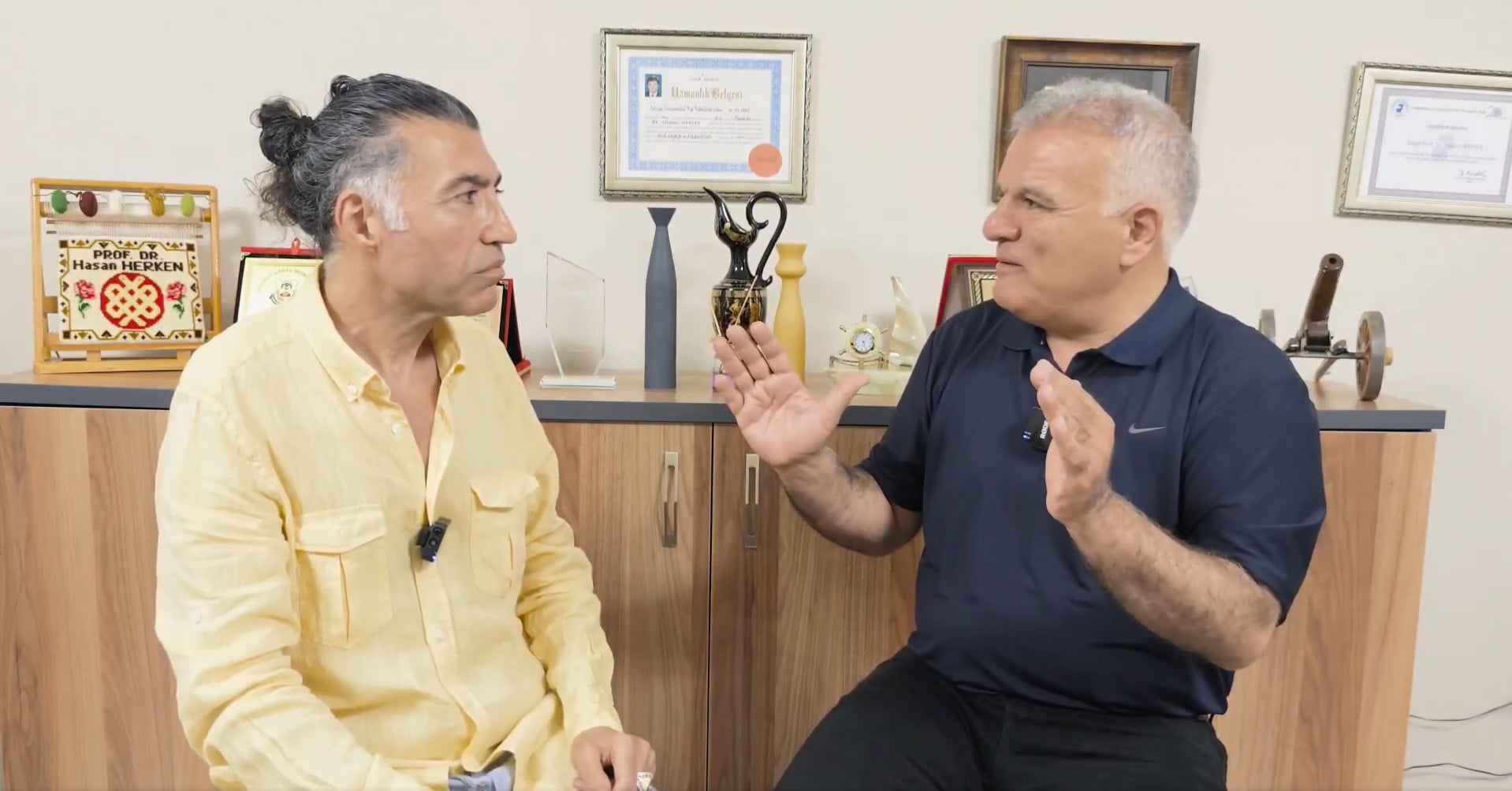
In a thought-provoking interview, former TRT news anchor Sırrı Er hosted renowned psychiatrist and academic Prof. Dr. Hasan Herken to examine one of Türkiye’s most pressing social issues: intellectual integrity.
Introducing the discussion, Er criticized the dominance of artificial agendas and the neglect of fundamental societal problems. He argued that one of the country’s greatest challenges is the erosion of what he described as “fikir namusu” — intellectual integrity and honesty in expressing one’s true beliefs.
To illustrate the concept, Er referred to a classic social psychology experiment known as the conformity experiment. In the example, participants are asked to identify the color of an object that is clearly green. However, when everyone else in the group deliberately insists that the color is red, individuals often abandon their own judgment and conform to the majority opinion.
“If a person knows the object is green but still says it is red because of social pressure, where does intellectual integrity stand?” Er asked.
Prof. Dr. Hasan Herken responded by highlighting the pioneering work of Turkish social psychologist Muzafer Sherif, widely regarded as one of the founders of modern social psychology. Herken noted that Sherif’s research demonstrated how powerful social influence can be in shaping human behavior, especially within societies where pressure and fear discourage independent thinking.
According to Herken, conformity often emerges because individuals fear exclusion from the group. In highly pressured environments, people may suppress their own perceptions and align themselves with the dominant narrative to protect their social standing and personal security.
“Leaving the herd becomes a frightening act. People feel compelled to adapt in order to maintain safety and acceptance,” Herken explained.
The academic further emphasized that prolonged exposure to social pressure can lead to collective denial and psychological dissociation. In such circumstances, societies gradually lose the ability to distinguish between genuine beliefs and publicly performed opinions.
Drawing attention to the political and cultural dynamics of the Middle East, Herken referenced the late psychiatrist Prof. Dr. Haluk Savaş, who famously argued that:
“Hypocrisy is the unofficial religion of the Middle East.”
Herken stated that in many societies, individuals develop separate public and private languages. While people may outwardly endorse certain views, both speakers and listeners often understand that those statements do not necessarily reflect genuine convictions.
The discussion also touched on the teachings of the 13th-century philosopher and mystic Mevlana Jalaluddin Rumi, whose famous principle, “Either appear as you are, or be as you appear,” was cited as a timeless reminder of authenticity and moral consistency.
“Before anything else, we must be human. We must strive to be the same person inwardly and outwardly,” Herken said, arguing that integrity remains one of the most essential virtues in a healthy society.
Concluding the interview, Sırrı Er reiterated that principles and values are more important than political affiliations or social trends. He emphasized that intellectual integrity requires individuals to defend truth and consistency even when facing pressure from their surroundings.
“Stand up for intellectual integrity,” Er said in his closing remarks. “Principles matter more than anything else.”
The interview has attracted attention among viewers interested in psychology, ethics, freedom of thought, and the challenges posed by social conformity in contemporary society.
Biliyorum, yapay gündemler bitmiyor.
— Sırrı Er (@konusmasanati) June 10, 2026
Biliyorum, gerçekler konuşulmuyor.
Biliyorum, vaktiniz kıymetli.
Biliyorum, işiniz başınızdan aşkın.
Fakat 6-7 dakikanızı ayırırsanız hiçbir şey kaybetmez, aksine çok şey kazanırsınız.
Güvenin bana…
Bu ülkenin en büyük meselelerinden biri… pic.twitter.com/JdugVuxagH
Former TRT Announcer Sırrı Er:
Ladies and gentlemen, I have a color in my hand. The color is green. I ask the people here, I ask Ali: “What color is this?” He says red.
Then I ask you: “What color is this, my child?” Ayşe says red.
I ask Fatma. There is no one saying green. Yet when asked about green, does she know it? Yes.
This is the red conformity experiment in social psychology.
Now Professor, is this social pressure? If someone says red because of environmental pressure, even though they know it is green, then where is intellectual integrity?
Please go ahead.
Prof. Dr. Hasan Herken:
I don’t know whether you have heard of Muzaffer Şerif. Professor Muzaffer Şerif is one of the founders of social psychology in the world.
Because he held alternative views, he came into conflict with the ruling administration in Turkey during the 1940s. At that time, Rüştü Saracoğlu was the Prime Minister. Muzaffer Şerif was on the verge of being arrested. Rüştü Saracoğlu, despite being Prime Minister, could not protect him from the atmosphere of pressure and advised him to leave the country.
He then went abroad and today is regarded as one of the fathers of social psychology in the United States.
What you are referring to is a social psychology experiment, a conformity experiment. Professor Şerif conducted many similar experiments.
I believe his surname before was Başaran. It is said that after marrying an American woman, he distanced himself from Turks. He eventually passed away in Alaska. He is considered one of the founding figures of both our sociology and social psychology traditions.
The situation you describe is exactly what is seen in oppressive societies. Social influence is extremely powerful. People end up conforming to the crowd because standing apart means separating from the herd. Everyone feels compelled to conform for the sake of their own security.
Social psychology is truly a remarkable field of study. You are directly referring to the conformity experiment, and you explained it very well.
For example, they show several lines. They point to a shorter line and say, “This one is longer.” The child initially says, “No, that one is longer.” Then each participant is asked in turn, and every one of them gives the wrong answer. When the child’s turn comes again, the child changes the answer and says, “Yes, yes, this one is longer.”
Even though the child knows the truth, once everyone else says the same thing, separating from the group becomes a major act and creates fear.
What happens when this process advances? Dissociation occurs, and a sense of denial develops. In oppressive societies, reality perception begins to deteriorate. Then social denial emerges. We see examples of this in places such as Kim Jong-un’s North Korea. Society becomes dissociated.
And in such societies, especially where democracy has never truly existed, people become hypocritical. Let me remember the late Professor Haluk. His observation was:
“The unofficial religion of the Middle East is hypocrisy.”
People make statements and repeat conventional phrases. Every group develops its own internal language and processes information differently.
In fact, when someone speaks this way, the other side often knows that the person is not being truthful. They know the statement is not sincere, yet everyone in the same circle understands that certain things must be said before reaching a particular point.
Everyone acts as though they believe it, even though they know it is not true.
Prof. Dr. Hasan Herken:
That is exactly where the issue lies.
Think of three sayings of Mevlana. One of them is:
“Either appear as you are, or be as you appear.”
Let’s see how many people know this. Very few actually do. Why? Because he was a wise man who understood human nature.
He said:
“Either appear as you are, or be as you appear.”
We should all internalize this principle.
I even use the word hypocrisy. Double standards, being two-faced—hypocrisy sounds like a mild word, but it exists in all of us.
Every worldview develops its own internal language. This has become an unofficial religion.
First, we must understand this. We need a kind of surgical operation: first, let us be human.
People who are not authentic and who do not live as they truly are become dissociated and remain under pressure.
There are different levels of this. The greater the pressure, the worse the outcome becomes.
Former TRT News Anchor Sırrı Er (Closing Remarks):
Yes, Professor, look, I have been talking about this for years. We have been discussing these issues together for years.
I do not see myself as the father or founder of psychology or psychiatry. I am nothing of the sort; I am just an ordinary man.
But I talk about these matters in these videos.
Principles matter.
Look, what is a principle?
A principle is important—more important than anything else.
I asked this question deliberately.
Stand up for intellectual integrity.
Stay well.