31 Ağustos 2026
açık


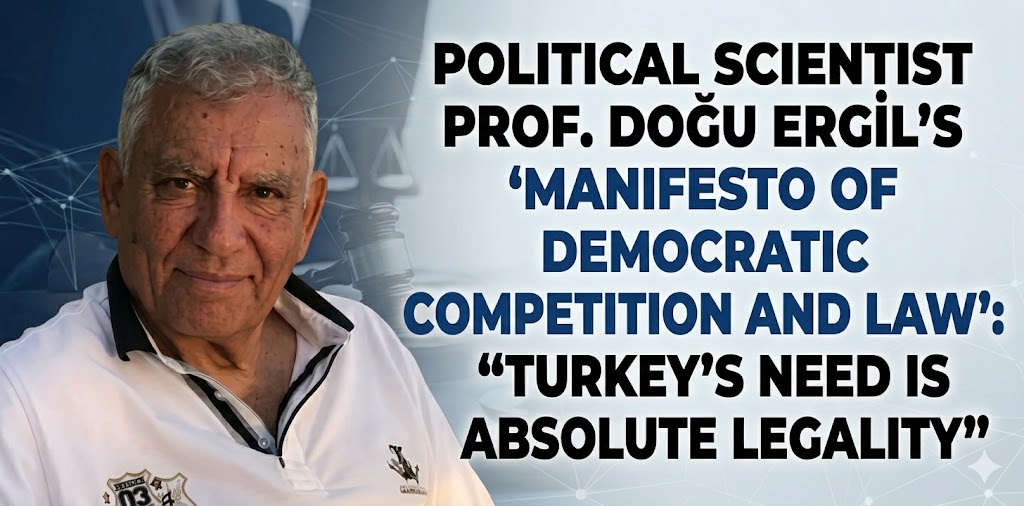
Political Scientist Prof. Doğu Ergil drew attention to the relationship between democracy, the rule of law, judicial independence, and economic stability in his “Manifesto for Democratic Competition and the Rule of Law.” Ergil stated, “What Türkiye needs is not absolute power, but absolute adherence to the rule of law.”
Democracy is not a regime in which those in power eliminate their rivals; it is a system in which they accept competing with them under equal conditions. The duty of the state is not to shape the political sphere, but to protect the rules of fair competition. When the existence of the opposition begins to be seen as a threat in a country, elections cease to produce representation and instead turn into mere displays of power. True legitimacy, however, is achieved not only by winning, but also by the losing side accepting the result as fair.
The purpose of law is not to suppress political struggle, but to regulate it through rules. When the judiciary becomes a strategic instrument of those in power, citizens’ trust in the state begins to erode. Because once people start believing that courts rule according to power rather than justice, the constitutional order may appear to survive on the surface while, in reality, it is steadily decaying. Selective application of the law weakens not only the opposition, but ultimately the state itself in the long run.
There is a direct relationship between economic stability and democratic trust. Capital seeks predictability; society seeks justice; young people seek a sense of future. In countries where political arbitrariness increases, money behaves short-term, brain drain accelerates, and productive capacity declines. Because no one wants to take long-term risks in a system where the rules change according to individuals. Democracy is therefore not only a moral necessity, but also an economic one.
What Türkiye needs is not absolute power, but absolute adherence to the rule of law. Political systems need strong institutions before strong leaders, merit before loyalty, and a shared sense of citizenship before political polarization. Preserving the meaning of elections requires defending not only the ballot box, but also the rule of law, freedom of expression, political competition, and institutional neutrality together. Because what emerges at the end of an unfair contest is not victory, but an authoritarian and unsustainable fragility.