04 Kasım 2026
parçalı bulutlu


According to CBRT’s March 2026 data, the net foreign exchange position deficit of non-financial corporations declined to $194.2 billion. The short-term net FX surplus rose to $10.1 billion.
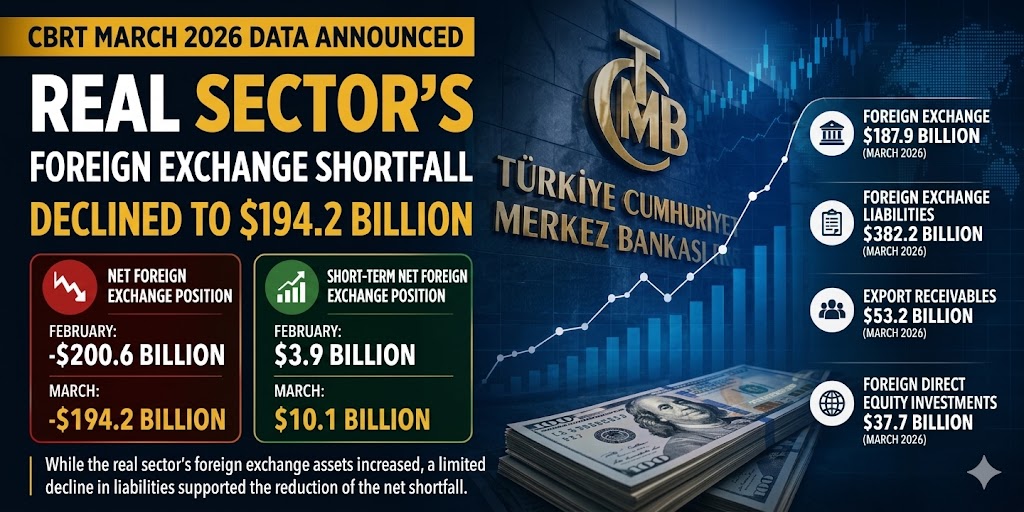
The Central Bank of the Republic of Türkiye (CBRT) published its March 2026 statistics on the “Foreign Exchange Assets and Liabilities of Non-Financial Corporations.” According to the data, the corporate sector’s net foreign exchange position deficit declined from $200.6 billion in February to $194.2 billion in March, marking an improvement of approximately $6.4 billion.
In March, total foreign exchange assets of firms rose to $187.9 billion, while total foreign exchange liabilities stood at $382.2 billion. Although the corporate sector’s net FX deficit remained at a high level, it showed a notable decline compared to the previous month.
The data also revealed a more significant improvement in the short-term foreign exchange position. The short-term net FX surplus increased from $3.9 billion in February to $10.1 billion in March. This development indicates that companies have strengthened their capacity to meet short-term foreign currency obligations.
The rise in foreign exchange assets was largely driven by an increase in deposits to $77.7 billion and direct investments abroad reaching $37.7 billion. Export receivables, meanwhile, stood at $53.2 billion.
On the liabilities side, cash loans amounted to $313.1 billion, of which $184.8 billion consisted of domestic borrowing. Loans obtained from abroad were recorded at $128.3 billion.
The data showed that the net FX deficit, which stood at $189 billion at the end of 2025, increased during the first two months of 2026 before returning to a downward trend in March. Nevertheless, the corporate sector’s approximately $194 billion open FX position highlights its continued sensitivity to exchange rate fluctuations.
Editor’s Note:
Although the March figures present a more favorable picture at first glance, a net FX deficit of $194.2 billion remains considerably high for Türkiye’s corporate sector. The increase in the short-term FX surplus suggests stronger liquidity management among firms, but long-term foreign currency indebtedness continues to represent a significant vulnerability. Achieving lasting improvement will require a more sustainable balance between foreign currency revenues and liabilities.
Kaynak: Central Bank of the Republic of Türkiye (CBRT)