10 Ağustos 2026
açık

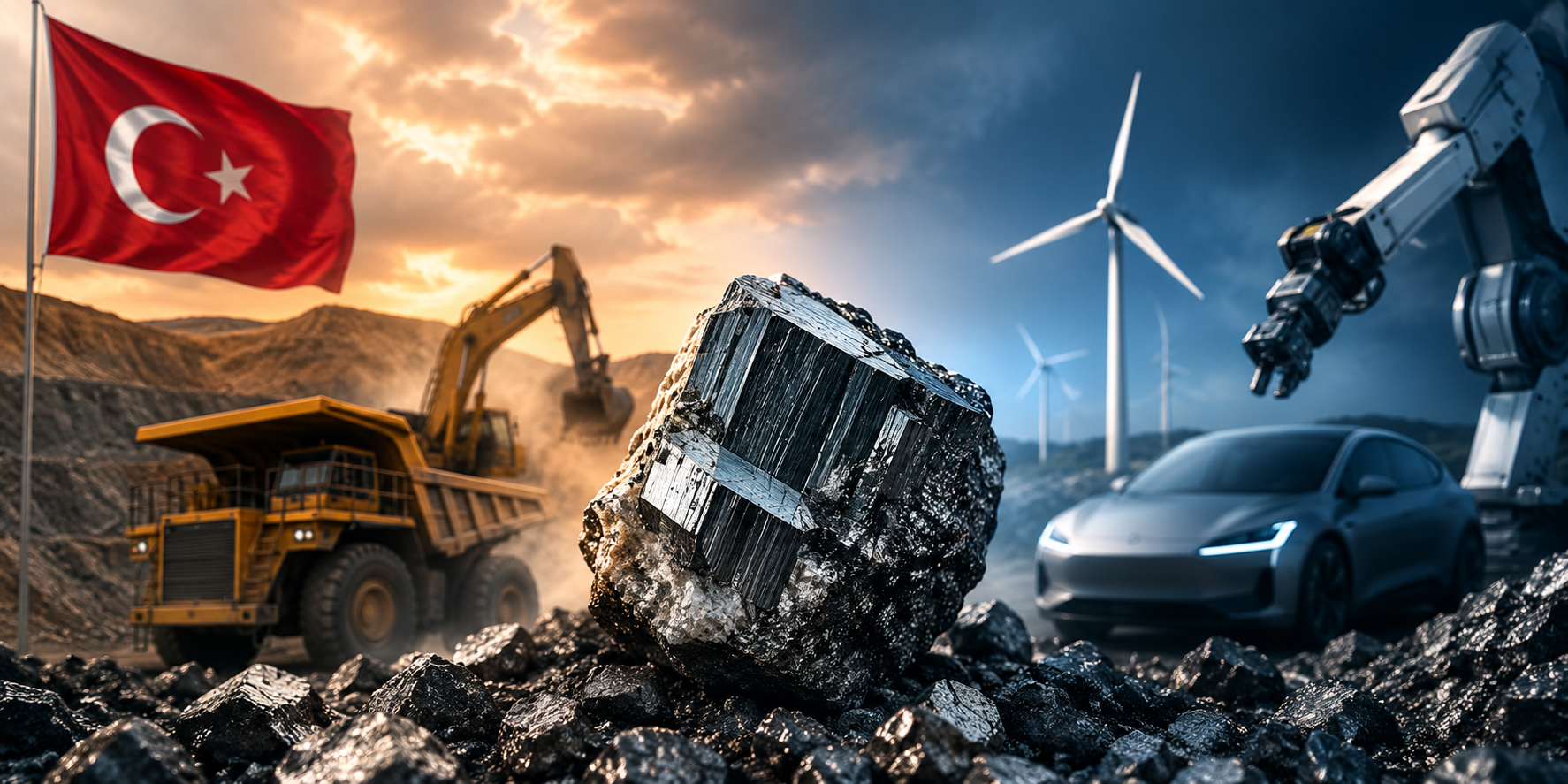
In the 20th century, global supremacy and economic dominance were dictated by crude oil. Nations fought wars, redrew maps, and forged historical alliances to maintain control over massive oil reserves. However, the paradigm is shifting rapidly. Today, the world is undergoing a massive transformation driven by green energy transitions and deep tech advancements.
In this new era, the most coveted resource is neither petroleum nor gold. The new currency of global power is Neodymium.
While this specific mineral rarely makes mainstream headlines, it has quietly become the centerpiece of a modern technological cold war. Here is an analytical breakdown of why this element is reshaping global dynamics and where Turkey stands in this high-stakes race.
Neodymium belongs to the “Rare Earth Elements” (REE) family, yet it stands out as the most strategically vital member. Its absolute indispensability stems from a single, extraordinary physical property: the ability to create the world’s most powerful permanent magnets (NdFeB).
These magnets can lift thousands of times their own weight. Without them, the infrastructure of the modern digital economy would grind to a halt. Neodymium is the foundational pillar for:
To put it bluntly: without neodymium, high-tech manufacturing is fundamentally impossible.
The frantic global scramble for neodymium is intensified not just by its utility, but by severe supply chain vulnerabilities.
Currently, the People’s Republic of China controls nearly half of the world’s natural rare earth reserves. More importantly, Beijing commands over 90 percent of the global processing capacity, turning raw extracted ore into highly specialized, industrial-grade magnets.
As a result, the United States and the European Union are aggressively looking to diversify their supply chains and establish independent logistics corridors to break away from total dependency on Beijing. This geopolitical shift has suddenly placed Turkey directly under the international spotlight.
This brings us to the critical evaluation: Does Turkey possess these vital resources, and what is its position on the global chessboard?
Turkey is emerging as a top-tier player in this strategic sector.
The nation’s premier Rare Earth Element deposit is located in the Beylikova (Kızılcaören) district of Eskişehir. Rigorous geological surveys conducted in this region have confirmed massive concentrations of Neodymium trapped within the ore.
With a declared 694 million tons of total complex ore reserves, the Beylikova site positions Turkey as the world’s second-largest reserve holder, trailing only China in sheer volume. While this figure represents the total unrefined ore body rather than pure elemental volume, the net extractable Rare Earth Oxides are more than enough to establish Turkey as a major geopolitical weight in the global tech sector.
Eskişehir’s massive geological potential hands Turkey an incredibly powerful diplomatic and economic trump card in international technology and energy negotiations.
However, the ultimate test for the nation lies in its industrial execution. Exporting unrefined, raw ore yields minimal economic margins and keeps a country at the bottom of the value chain. True sovereignty and economic victory lie in building local, high-tech processing plants capable of refining neodymium and manufacturing “Neodymium Magnets” domestically.
If Turkey successfully executes this vertical integration, it will transcend its traditional role as a mere energy transit corridor. Instead, it will transform into one of the world’s primary industrial hubs for advanced technology infrastructure. The vision for the new century depends entirely on this industrial leap.