13 Ekim 2026
parçalı bulutlu


Some cities are written not only on maps by history, but also into the memory of a nation.
Ankara is one of those cities.
Once a modest town nestled in the vast Anatolian steppes, Ankara became the center of decisions that would change the course of history when a nation’s struggle for independence began.
On October 13, 1923, Ankara’s designation as the capital was more than the selection of an administrative center. It was a declaration to the world of the future a newly established state envisioned for itself.
Ankara was not merely a geographical center. It became a symbol of independence, national sovereignty, and the determination to rise again.
Istanbul, the capital of the Ottoman Empire, had served as the empire’s political and administrative center for centuries. However, the occupation that followed the First World War also demonstrated how vulnerable this historic city could be.
This was where Ankara’s importance emerged.
When Mustafa Kemal Atatürk arrived in Ankara on December 27, 1919, the city became the administrative center of the Turkish National Struggle.
The opening of the Grand National Assembly of Türkiye in Ankara on April 23, 1920, marked one of the most significant steps in this transformation.
Decisions were now being made here, the struggle for independence was being directed from here, and the nation’s future was taking shape here.
Ankara had become the heart of the National Struggle before it was officially declared the capital.
Sometimes, a city’s destiny is not determined by its population, wealth, or magnificent buildings. At times, history entrusts its greatest responsibilities to places that appear the most modest.
Ankara’s story was precisely that.
So, why Ankara?
The answer cannot be found solely in security considerations.
Istanbul was undoubtedly vulnerable to external intervention because of its proximity to maritime routes and the Bosphorus. Ankara, situated in the interior of Anatolia, offered significant defensive advantages.
Its railway connections and communication facilities also played a role in its selection.
Yet there was a deeper dimension to the decision.
Istanbul represented the history and traditions of a long-established empire. Ankara, by contrast, stood at the center of a new political will that had emerged through the struggle for independence.
On one side stood the capital of the past; on the other, the center of the future state.
The decision to make Ankara the capital was a powerful indication that Türkiye was opening a new political chapter.
The choice revealed not only where the state would be governed, but also the source of its political authority.
The nation’s right to determine its own future had become the foundation of sovereignty.
Following the ratification of the Treaty of Lausanne, the evacuation of Istanbul by the occupying Allied forces on October 2, 1923, brought the question of the capital back to the forefront.
During this process, İsmet Pasha and his colleagues submitted a single-article bill to the Grand National Assembly of Türkiye on October 9, 1923.
The proposal stated:
“The seat of government of the State of Türkiye is the city of Ankara.”
In other words, Ankara would become the administrative center of the Turkish state.
On October 13, 1923, the proposal was adopted, officially declaring Ankara the capital of Türkiye.
Only days remained before the proclamation of the Republic.
The political center of the new state had been legally established ahead of the historic transformation that would take place on October 29, 1923.
Only 16 days separated Ankara’s designation as the capital from the proclamation of the Republic.
This proximity made the historical connection between the two decisions even more significant.
First, the center of the new state was established. Then, the Republic was proclaimed as the country’s form of government.
Thus, the political will that had taken shape in Ankara during the National Struggle found expression in the institutional structure of the new state.
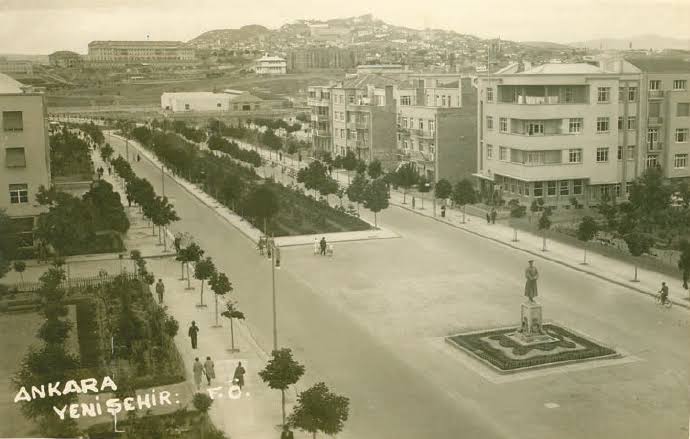
When Ankara was declared the capital, it was far removed from the city we know today.
Its population was limited. Its infrastructure was inadequate. The public buildings, transportation facilities, and urban planning arrangements required by a new state had yet to be developed.
But becoming the capital was not merely a new title for Ankara. It marked the beginning of a major transformation.
Urban planning projects created new residential areas. Public institutions were built. New centers emerged in education, culture, and the arts.
Planning projects prepared by urban planners such as Hermann Jansen played a role in Ankara’s development as a modern capital.
Districts such as Ulus and Kızılay became symbols of the city’s changing identity.
Once a modest Anatolian town in the middle of the steppes, Ankara gradually transformed into the administrative and political center of the new Türkiye.
Of course, this transformation did not happen overnight. Building a capital means much more than constructing roads and buildings. It also means establishing institutions, envisioning a shared future, and developing a social structure capable of sustaining that future.
Ankara’s story is about far more than the growth of a city: it is the story of a nation striving to rebuild its own future.
To understand Ankara, it is not enough to look only at its present-day streets, squares, or public buildings.
The city carries the memory of the difficult days of the struggle for independence.
Decisions made in parliamentary chambers, reports arriving from the front lines, choices shaped by enormous responsibilities, and hopes for the future…
Ankara became the capital by passing through all these experiences.
For this reason, its status as the capital cannot be viewed merely as an administrative arrangement. It is also a historical expression of national sovereignty and the determination to establish an independent state.
A nation’s choice of capital also reveals how it defines itself.
The decision to choose Ankara demonstrated that Türkiye was establishing its new state structure around a political will rooted in Anatolia.
In this respect, Ankara is not simply the city from which Türkiye is governed. It is one of the most important places in the founding story of the Republic.
When we look back at October 13 today, we are remembering more than a historic date on the calendar.
We are remembering a nation’s transition from a struggle for independence to the establishment of a state, the responsibility undertaken by a city on the stage of history, and a choice that helped shape the future.
Ankara’s designation as the capital reminds us of an important truth:
A country’s strength is measured not only by the legacy of its past, but also by the values on which it builds its future.
Through its journey from the headquarters of the National Struggle to the capital of the Republic, Ankara became a symbol of this historic transformation.
This story, which began in the middle of the steppes, was shaped by a nation’s determination to secure its independence.
And with the decision taken on October 13, 1923, Ankara became more than the capital of Türkiye.
It became the heart of a nation’s new beginning, its determination to remain independent, and its march toward the Republic.