20 Ekim 2026
parçalı bulutlu


Electoral law and institutional jurisdictional boundaries are the foundation of the constitutional order, moving beyond mere politics. The YSK’s rejection of the “certificate of election cancellation” request is not just a convention debate; it is a critical message for protecting the will manifested at the ballot box and the legal security of election results. In line with this clear stance, Özgür Özel legally still occupies the position of CHP Chairman. The real question is: will politics shape the law, or will the law draw the boundaries of politics?
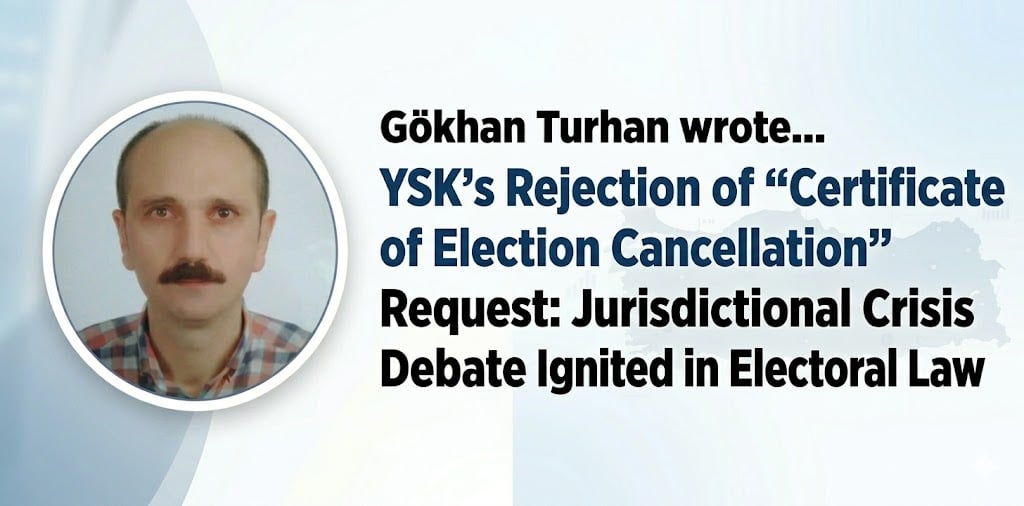
In Turkish politics, developments sometimes emerge that shift the focus away from political parties and toward the boundaries of state institutions. The recent controversy surrounding the CHP congress is precisely such a case.
The Supreme Election Council’s (YSK) decision to return the request regarding the annulment of certificates of election (mazbatas) is not merely a technical act. It also represents a reminder of the fundamental principles of electoral law within the state system.
Because the issue is not simply about who leads the CHP.
The real issue is which authority has the power to invalidate an electoral outcome.
The YSK’s stance is quite clear:
“Certificates issued following an election conducted within the framework of the Constitution and laws are valid. These results are evaluated within the rules of electoral law.”
For this reason, the Council’s decision is interpreted by many legal experts as a defense of institutional jurisdiction.
What is crucial here is this:
A court may examine the legal validity of a party congress. It may evaluate procedural aspects of the congress. However, the question of how an electoral outcome certified by the YSK can be annulled belongs to a different legal domain.
This is precisely why the YSK’s response carries significance beyond political debate and directly relates to constitutional order.
The dispute we see today regarding the CHP could set a precedent for other political parties tomorrow.
If electoral outcomes could easily be overturned through mechanisms outside electoral law, the consequences would affect not only one party but the entire electoral system.
In democratic regimes, not only electoral security but also the legal certainty of election results is essential.
The will expressed at the ballot box must have a clear, predictable, and legally defined framework for when and how it can be altered.
From this perspective, the essence of the YSK’s decision can be summarized in one sentence:
“The legitimacy of elections is protected within the rules of electoral law.”
In the coming period, decisions made by judicial bodies will of course continue to be debated. However, it appears that the YSK has taken a very firm stance in protecting its jurisdiction.
Therefore, based on the current situation and from the perspective of electoral law, Özgür Özel remains both de facto and de jure the leader of the CHP.
The real question is this:
In Turkey, will political debates determine the law, or will the law define the limits of political debate?
The answer will shape not only today, but also all future political processes.