09 Ağustos 2026
kapalı


Analysis suggests a SpaceX Falcon 9 upper stage likely impacted the Moon, creating a crater near Einstein — implications for lunar debris tracking and science.
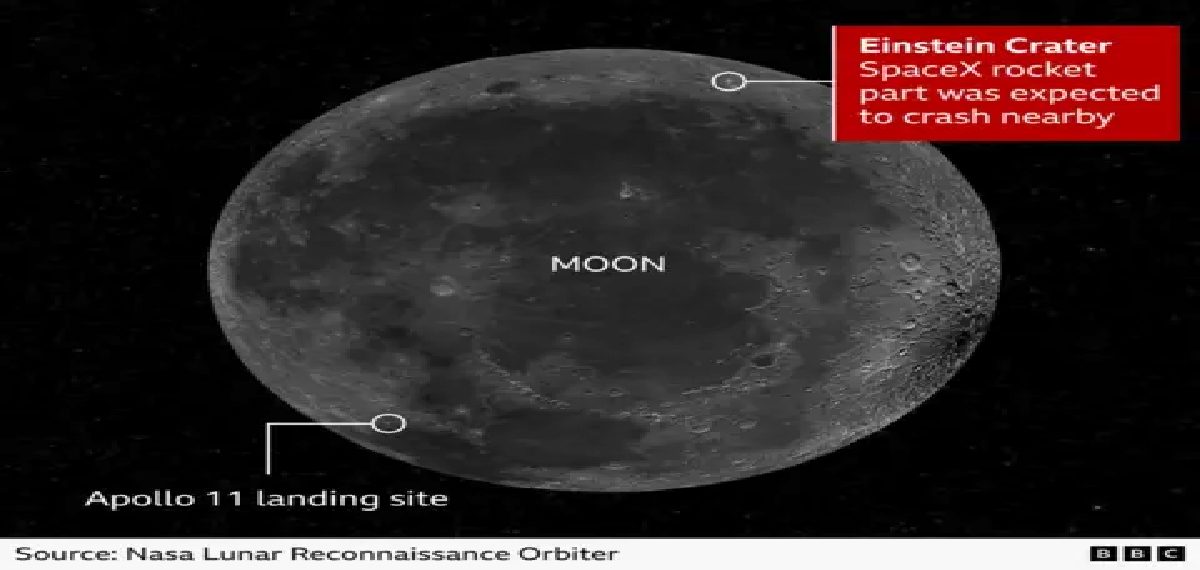
The empty upper stage of a SpaceX Falcon 9 rocket is believed to have impacted the Moon near the Einstein crater at about 07:35 BST (06:35 GMT), producing a faint flash and a possible dust plume visible for minutes, according to observations and tracking data.
The spent stage, roughly the size of a five‑storey building and weighing at least 4,000kg, was left in a looping orbit after a January launch that sent two lunar landers on their way. Small gravitational tugs from Earth, the Moon and Sun, together with solar radiation pressure, altered its path over 18 months and placed it on a collision course that increased its speed toward the lunar surface.
The impact occurred in daylight for many regions, so the brief flash would have been difficult to detect visually. Amateur observers working in darkness were also unlikely to see the millisecond flash, though some reported the possibility of a dust plume extending as far as 100km that could linger for several minutes.
Observatories in the Americas that had dark skies at the time are analysing observations, while orbital assets will attempt imaging. South Korea’s Danuri orbiter passed near the crash site shortly before the impact and its team has indicated any footage will be released after analysis. NASA’s Lunar Reconnaissance Orbiter is scheduled to image the area in the coming days to enable before-and-after comparisons.
Because the rocket stage’s dimensions, mass, speed and impact point are known, researchers can treat the collision as a constrained experiment to test models of crater formation, ejecta distribution and subsurface excavation. The event offers an opportunity to measure how much material is lofted, the distance debris can travel, and to retrieve fresh subsurface samples for geological study, all using existing observational assets.
Analysis of collected images and telescope data will require image processing that may take hours to weeks as teams verify and clean the observations before drawing scientific conclusions.