14 Ekim 2026
kapalı


KOSPI tumbles 5.5% amid AI-driven selling while Bitcoin stages a recovery, highlighting divergent market risks and investor sentiment.
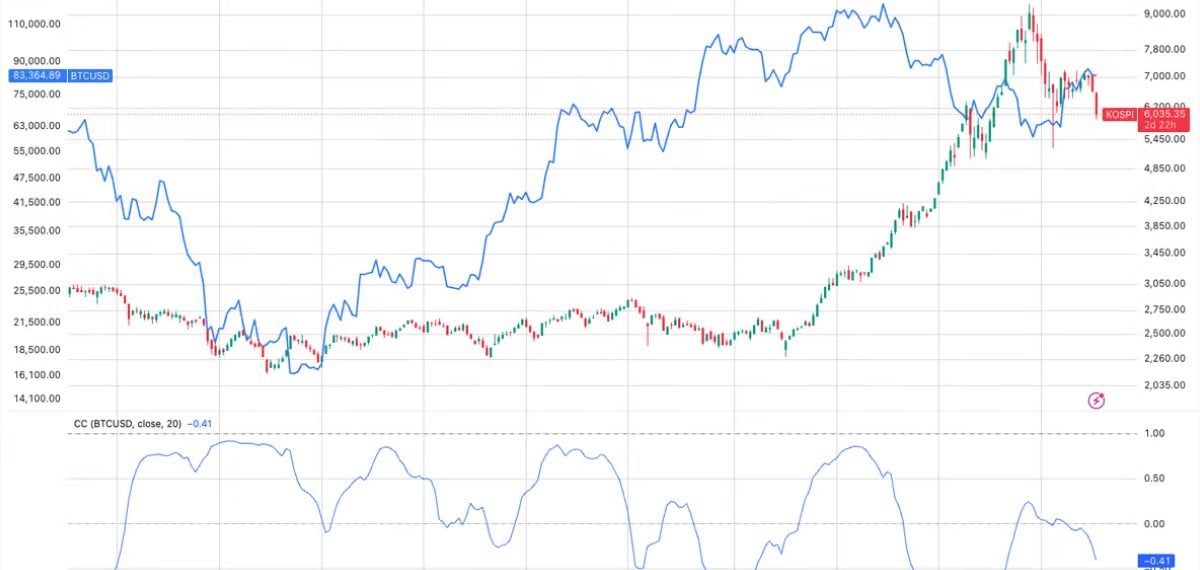
The South Korean stock market experienced a steep selloff on Tuesday, with the KOSPI tumbling 5.5% during Asian trading hours. This decline places the index about 38% below its June record high, extending a reversal that now sits in sharp contrast to bitcoin’s recent strength.
While the KOSPI fell, bitcoin staged a sizable rebound—recovering from a low near $58,000 shortly after the KOSPI peak and rising to around $87,000. On a weekly basis, the 20-day rolling correlation between bitcoin and the KOSPI sits at -0.41, a moderately negative relationship that suggests the two assets have moved in opposite directions through this episode.
Market sentiment shifted after Broadcom CEO Hock Tan compared speculative AI investing to casino gambling, comments reported by the Financial Times that heightened doubts about whether AI-driven spending can produce returns sufficient to justify massive infrastructure investments. Those remarks amplified investor caution toward high-flying AI names.
Competitive pressures also weighed on chip stocks. Advances by Chinese memory-chip maker CXMT raised concerns about margin sustainability for established suppliers, a dynamic highlighted by Bloomberg. As a result, major Korean memory players were hit hard—SK Hynix fell roughly 10% and Samsung Electronics declined about 7%.
The weakness in semiconductor-related names extended into U.S. premarket session, with memory and storage companies such as Micron Technology (MU) and SanDisk (SNDK) each trading down by about 3%. These moves reflect investor anxiety over competition, margins and the broader viability of the intense capital spending tied to AI and memory capacity expansion.
Important: A negative correlation between bitcoin and the KOSPI does not prove capital is rotating directly from one asset to the other. Correlation is only one indicator of relationship and must be considered alongside flows, positioning and fundamental drivers.