26 Kasım 2026
açık


Gold and Bitcoin shed safe‑haven status as Sharpe ratios converge, signaling shifting risk premiums and asset allocation implications for investors.
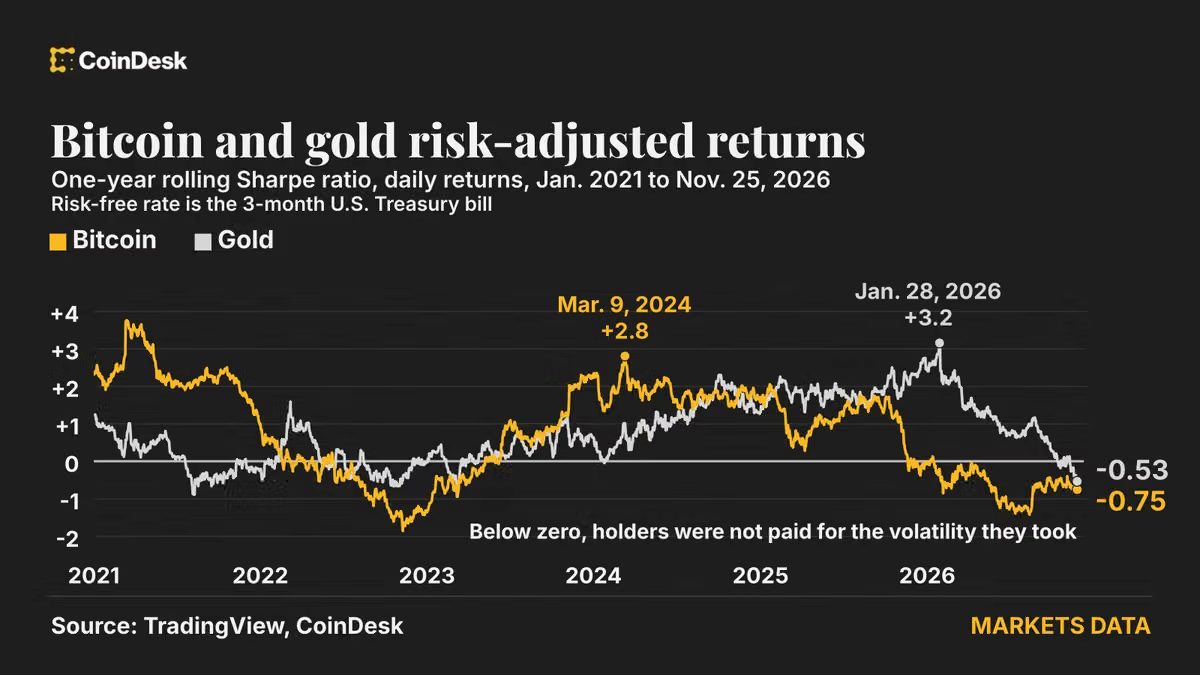
Gold and bitcoin have both shifted from offering positive risk‑adjusted returns to failing to compensate holders for their volatility, according to recent calculations that show a notable convergence in one‑year Sharpe ratios.
Over the past year gold maintained an edge over bitcoin as a haven asset, yet that advantage has vanished with gold’s one‑year Sharpe ratio recently at -0.53 and bitcoin’s at -0.75. Both readings indicate neither asset is compensating investors for volatility relative to the U.S. three‑month Treasury bill, a commonly used risk‑free benchmark.
The convergence of these metrics does not imply a fundamental alignment between the two assets. HashKey Group’s senior researcher Tim Sun said a decline in gold’s Sharpe ratio does not mean bitcoin is becoming a superior safe‑haven asset and argued that investors are reassessing allocations across the non‑yielding asset class, with competition from cash‑equivalent assets and high‑grade bonds offering certain yields.
Historical patterns illustrate how rapidly conditions changed this year. Gold’s one‑year rolling Sharpe ratio had been comfortably positive since April 2023, peaking at 3.2 on Jan. 28, 2026, before a sharp reversal. Bitcoin’s Sharpe ratio has been negative since November after earlier peaks including 2.8 in March 2024.
Price declines have driven much of the erosion in risk‑adjusted returns. Gold peaked at $5,589 an ounce on Jan. 28 before falling about 37 percent, while bitcoin has dropped roughly 33 percent since the start of the year to near $59,000. Bitcoin’s price swings remain larger than gold’s, keeping it the riskier asset.
Market participants attribute pressure on both assets to a stronger U.S. dollar and a shift in Federal Reserve expectations that began with Kevin Warsh’s nomination as Fed chair in January and the Fed’s later decision to abandon an easing bias and adopt a more hawkish stance. A stronger dollar raises dollar‑priced asset costs for international buyers and higher interest rates weigh on non‑yielding assets such as gold and bitcoin.
Despite the recent deterioration, longer horizons still favor gold on a risk‑adjusted basis. Over three years gold’s Sharpe ratio stands at 0.77 versus 0.46 for bitcoin, and over five years gold leads 0.60 to 0.21. These benchmarks show gold has outpaced bitcoin on risk‑adjusted returns across institutional timeframes, though bitcoin’s longer‑term performance improved during periods such as when the Nasdaq‑listed firm MSTR began buying bitcoin in 2020.
The simultaneous decline in Sharpe ratios for gold and bitcoin signals a broader reallocation toward yield‑bearing, cash‑equivalent assets rather than a transformation of bitcoin into a superior safe‑haven. Investors appear to be prioritizing predictable income from high‑grade bonds and near‑cash instruments amid a stronger dollar and a more hawkish Federal Reserve stance. The rapid fall in gold’s previously exceptional trailing performance has narrowed the gap between the two assets, but multi‑year metrics continue to show gold holding a structural advantage on a risk‑adjusted basis.