27 Kasım 2026
açık


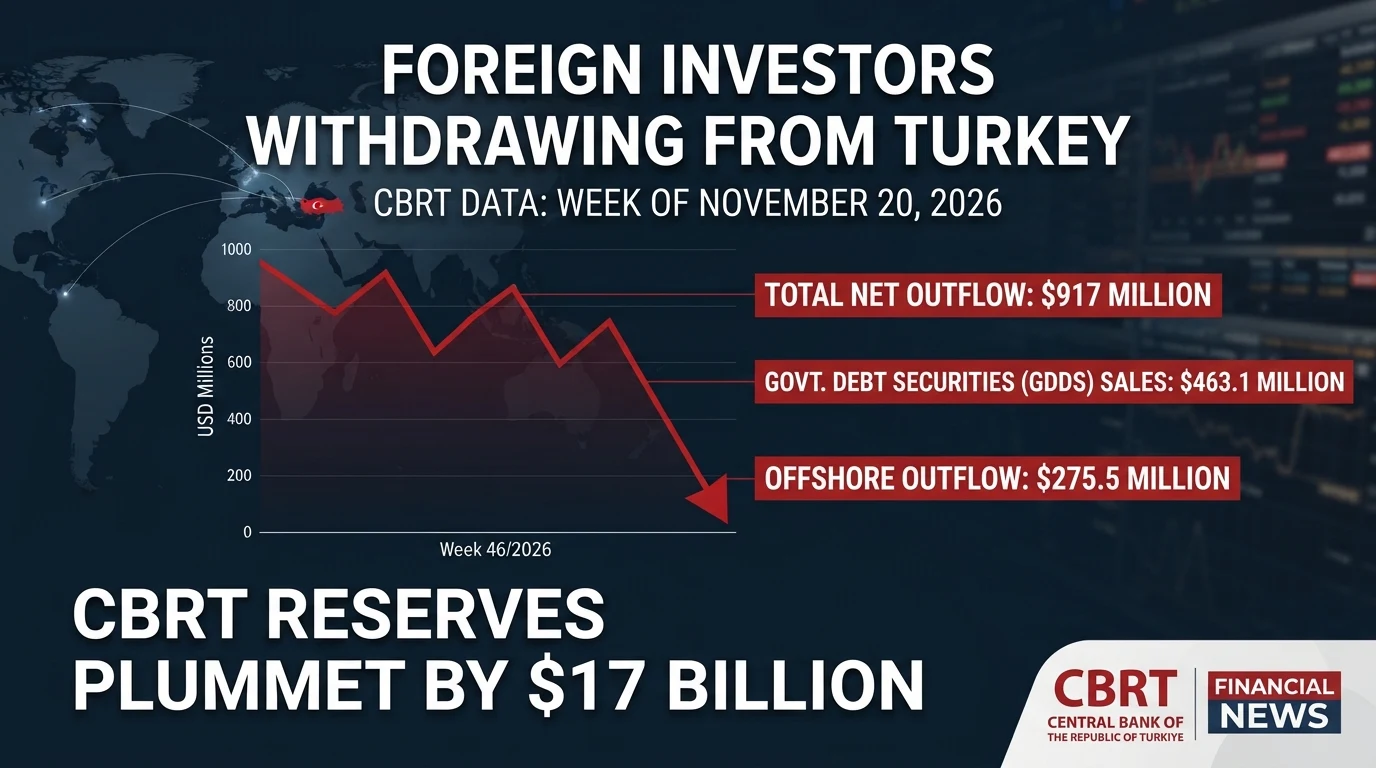
The Central Bank of the Republic of Türkiye’s (CBRT) securities statistics for the week ending November 20, 2026, reveal a significant reduction in foreign investors’ exposure to Turkish markets. After a modest inflow the previous week, foreign investors recorded net outflows of $917 million, adjusted for market price and exchange rate effects. Government domestic debt securities (GDDS) accounted for the largest share of selling, with net outflows of $463.1 million. Overseas markets also saw $275.5 million withdrawn. The simultaneous decline of approximately $17 billion in Central Bank reserves has renewed concerns about investor confidence and capital movements.
News: Gökhan Turhan
Foreign investors significantly reduced their positions in Turkish financial markets during the week ending November 20, according to the latest securities statistics released by the Central Bank of the Republic of Türkiye (CBRT).
Data adjusted for market price and exchange rate/parity movements showed total net outflows of $917 million. This marked a sharp reversal from the previous week, when foreign investors recorded a modest net inflow of $4.5 million.
Government bonds bore the brunt of foreign selling. Net outflows from domestic markets reached $641.5 million, of which $463.1 million came from government domestic debt securities (GDDS). Equities recorded net sales of $48.4 million, while other domestic issuances registered an additional net outflow of $130.1 million.
Selling also accelerated in overseas markets. Foreign investors withdrew a net $275.5 million from these instruments, including $258.7 million from general government issuances. The figures point to increasingly pronounced selling in Eurobonds, while other overseas issuances recorded net outflows of $16.8 million.
Two weeks of buying give way to selling
The shift was particularly notable compared with the figures for the week ending November 13. During that period, foreign investors had made net purchases of $246.8 million in equities and $97.6 million in GDDS. By November 20, both categories had moved into net selling territory.
The reversal in investor positioning within a short period highlights the change in foreign investors’ risk appetite.
The market value of foreign investors’ total securities portfolios also declined considerably. Holdings fell from $138.3726 billion to $134.5706 billion, representing a weekly decrease of $3.802 billion.
The value of domestic market holdings dropped by $2.8999 billion to $49.0593 billion. Equity holdings declined by $2.1635 billion to $31.7353 billion, while the market value of GDDS holdings fell by $597.5 million to $15.2791 billion.
Not all of the portfolio decline reflects actual selling
The $2.16 billion decline in the market value of foreign equity holdings stands in contrast to net equity sales of just $48.4 million. This difference indicates that most of the decline in portfolio value resulted from falling share prices on Borsa İstanbul rather than direct foreign investor selling.
A similar pattern emerged in government debt securities. Their market value declined by $597.5 million, while net sales amounted to $463.1 million. Changes in bond prices also contributed to the difference.
The market value of overseas holdings decreased by $902.1 million to $85.5113 billion. General government issuances accounted for $766.4 million of that decline, bringing their total market value down to $45.0605 billion.
Confidence concerns deepen following the fund crisis
The latest foreign investor outflows are being assessed against the backdrop of weakening confidence following the investment fund crisis that emerged in mid-September. Developments involving Pusula Portfolio Management and other similar cases, along with fund liquidations, have intensified concerns about confidence in the financial system.
During the same week, the CBRT’s total reserves fell by approximately $17 billion, declining to around $142 billion. Net reserves excluding swaps reportedly dropped to approximately $11–12 billion. Estimates also suggest that the Central Bank’s cumulative foreign currency sales since the fund crisis began have approached $28 billion.
Türkiye’s five-year credit default swap (CDS) premium rose to the 274–285 basis-point range, reaching its highest levels in seven months. The BIST 100 index remained under pressure, trading within the 10,600–11,100 range, while the foreign investor custody ratio declined. The USD/TRY exchange rate traded between 50.5 and 50.7.
Risk reduction is concentrated in the bond market
The figures indicate that foreign investors have focused particularly on reducing their exposure to GDDS and Eurobonds. The scale of selling in the bond market points to increased sensitivity to risk premiums and interest rate movements.
By contrast, net selling in equities remained relatively limited. This suggests that the sharp decline in the market value of foreign equity holdings should not be interpreted as evidence of an equally large wave of foreign selling. The distinction between net capital flows and changes in portfolio market value is therefore essential when assessing the latest figures.
Coming weeks will determine whether the trend persists
The $917 million net outflow recorded in the week ending November 20, together with the sharp decline in Central Bank reserves, highlights the continuing pressure on Türkiye’s financial markets.
Foreign investors’ decision to reduce their exposure particularly to fixed-income instruments suggests that uncertainty following the fund crisis continues to influence capital movements.
The CBRT’s securities and reserve statistics in the coming weeks will be crucial in determining whether the latest selling represents a temporary adjustment or the beginning of a more lasting shift in foreign investor positioning.
EDITOR’S NOTE
The withdrawal of $917 million in a single week is a warning that cannot be ignored by financial markets. However, attributing the entire picture to foreign investor selling would overlook the deeper issues. The loss of confidence in the investment fund sector, questions surrounding transparency and supervision, and the sharp decline in reserves must be considered together. Economic confidence cannot be built through interest rates and reserve figures alone. It also requires predictable rules, effective oversight and accountable institutions. Expecting lasting confidence from foreign investors without addressing these structural concerns is unrealistic.
Note: The figures are provisional and may be revised in subsequent releases.
Kaynak: CBRT Securities Statistics, week ending November 20, 2026.