12 Ekim 2026
parçalı bulutlu


Timeline of Kenya’s first confirmed Ebola case: cross-border movements, missed detection points, and public health implications.
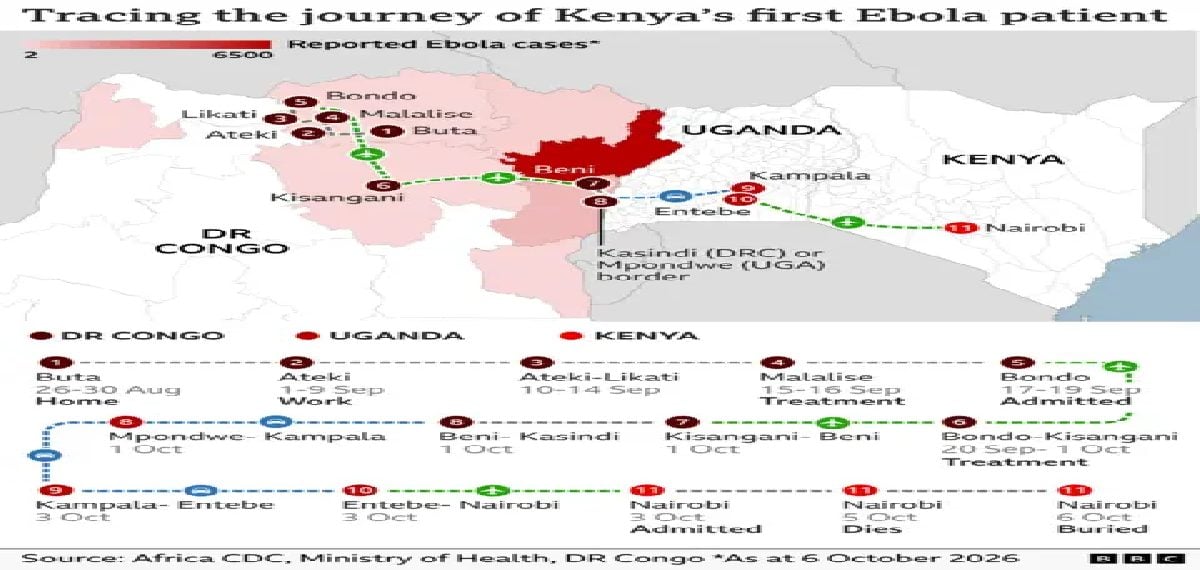
The man who became Kenya’s first confirmed Ebola patient traveled across three countries while his illness progressed, only being diagnosed after he reached a Nairobi hospital in critical condition. He died two days later, on 5 October, raising serious questions about screening and clinical detection during a major outbreak.
Investigators have traced his movements over nearly six weeks, revealing multiple missed opportunities to identify the disease and limit potential exposures. More than 4,000 deaths have been recorded in the Democratic Republic of Congo (DR Congo) during this outbreak, making the failure to detect this case earlier a pressing public health concern.
The patient, a 40-year-old businessman who had lived in DR Congo for seven years, traveled for work across at least three Congolese provinces. His symptoms began around 15 September. Initially he received antibiotics and was sent home; two days later he was admitted to a health centre in Bondo where he remained until 19 September. Clinicians there diagnosed a skin infection despite fever and rash, and no Ebola test was performed during that period.
On 20 September he took a domestic flight to Kisangani, a regional capital where he sought care for more than ten days. Records do not clarify which facilities treated him or what therapies were given. Kisangani is in Tshopo province, which has reported relatively few Ebola cases compared with other hotspots.
On 1 October the man flew to Beni and then traveled to Kasindi, a busy border town in North Kivu — one of the provinces hardest hit by the outbreak. Later that day he crossed into Uganda and traveled by road to Kampala, then to Entebbe Airport. Uganda, which has experience containing Ebola, had imposed movement restrictions and runs airport screenings; officials said his temperature was normal during airport checks.
Temperature screening limitations: Health authorities note that reliance on fever checks and declarations has clear limits. Investigators are considering whether medication suppressed his temperature or whether he simply did not have a measurable fever at the time of screening.
He arrived in Nairobi on 3 October. A relative collected him and drove him directly to Nairobi Hospital, where he presented with fever, chills, muscle pain, sore throat and bleeding. Laboratory testing confirmed infection with the Bundibugyo species of Ebola — the same strain circulating in DR Congo — and he was isolated. His condition worsened and he died on 5 October; his funeral the next day followed strict infection‑control measures.
Kenyans authorities have identified dozens of possible contacts since his arrival; the World Health Organization expects the number to rise as contact tracing continues in Uganda and DR Congo. The Kenyan government also reports having screened hundreds of thousands of travellers and trained thousands of health workers, but this case highlights gaps between planning and real-world detection.
Transmission and incubation: Ebola spreads through direct contact with bodily fluids of symptomatic people or contaminated materials. The incubation period ranges from two to 21 days, so exposed individuals may not develop symptoms for several weeks.
Call for early reporting: Africa CDC’s emergency director urged anyone with Ebola-like symptoms to seek care promptly. Early reporting both improves a patient’s survival prospects and reduces the risk of onward transmission. The World Health Organization warns that stigma can deter people from reporting symptoms, which undermines disease control efforts.
WHO and partner agencies are increasing community engagement to counter misinformation — a critical task in regions where fear and mistrust have sometimes led to attacks on health workers. Strengthening frontline clinical suspicion, improving diagnostic testing access, and recognizing the limits of border temperature screening are key lessons from this case.
| Key event | Date |
|---|---|
| First symptoms reported | Around 15 September |
| Admission to Tongo Etandi Health Centre (Bondo) | 17–19 September |
| Travel to Kisangani | 20 September |
| Travel to Beni and Kasindi (North Kivu) | 1 October |
| Crossed into Uganda; flew to Nairobi | 3 October |
| Laboratory confirmed Ebola (Bundibugyo) | 4 October |
| Death | 5 October |
For ongoing coverage and official guidance, public health agencies urge people to follow WHO advisories, report symptoms promptly, and avoid stigma that may hinder outbreak control.