14 Kasım 2026
açık


In his UN General Assembly speech, Iran’s president also accused the US and Israel of illegal attacks on civilians as the US delegation walked out. He closed with a direct message to Trump: “Yes they did hit us, but we did not bend the knee.”
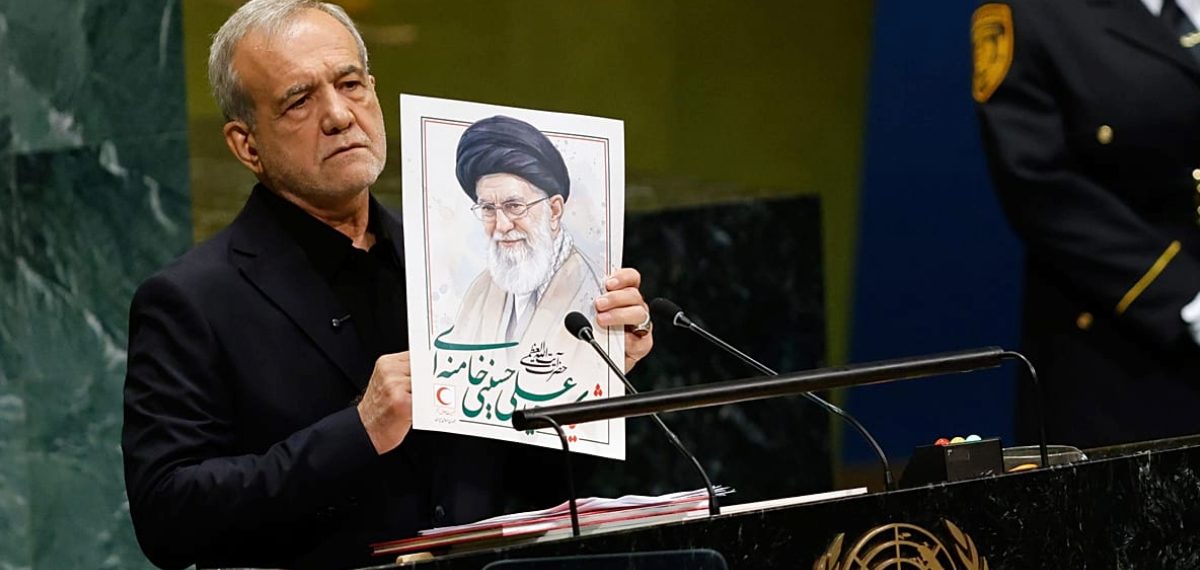
Iranian President Masoud Pezeshkian used his address to the United Nations General Assembly on Wednesday to reject Washington’s portrayal of Iran as a source of terrorism and instability, declaring instead that the Islamic Republic had been the target of attacks.
Speaking one day after US President Donald Trump warned that he could “annihilate” Iran if a deal was not reached, Pezeshkian delivered a forceful defense of Tehran’s position while also leaving open the possibility of negotiations.
Pezeshkian began his speech by displaying photographs of children killed in an attack on a school in Minab, southern Iran, as well as an image of former Supreme Leader Ayatollah Ali Khamenei, who was killed at the beginning of the conflict. He said the images represented what he described as the human cost of US and Israeli military operations against Iran.
“The US president described us as terrorists. We have been the victims of terrorism,” Pezeshkian said.
The Iranian president argued that Tehran’s military capabilities were intended for defense rather than aggression and accused the United States and Israel of targeting civilians and infrastructure. The US delegation walked out of the General Assembly chamber during his remarks.
Pezeshkian also challenged the international approach to Iran’s nuclear program, arguing that nuclear technology for peaceful purposes should not be restricted to a small group of countries. He maintained that the dispute could not be resolved through military pressure.
Turning to Israel, he highlighted what he described as a double standard over nuclear capabilities and international inspections, while accusing Israel of military attacks and Iran of facing sanctions.
The Strait of Hormuz was another central theme of his address. Pezeshkian said Iran would resist efforts to restrict its access to the waterway, which has become a major point of contention during the conflict.
He warned that lasting security in the Middle East could not be achieved by one country acting alone.
“No one in this region will enjoy security alone,” he said, arguing that regional states must either establish security collectively or face continuing instability.
Pezeshkian ended his speech by directly addressing Trump, saying Tehran remained prepared to pursue dialogue and negotiations but would not accept diplomacy conducted under military threats.
His remarks came amid renewed but inconclusive contacts between US and Iranian officials in New York. Trump said after a meeting involving his representatives and Iranian officials that the discussions had been positive, while acknowledging that the Iranian delegation did not include the country’s highest-ranking leadership.
Iranian officials subsequently played down the significance of the exchange, while US Secretary of State Marco Rubio characterized it as a continuation of previous discussions rather than a major diplomatic breakthrough.
The Pezeshkian administration’s portrayal of Iran as a victim drew a sharp response from US officials, who accused Tehran of ignoring its own actions during the conflict.
Rubio questioned Iran’s standing to criticize the international system and its human-rights record, reflecting Washington’s broader argument that Tehran bears responsibility for regional violence.
At the same time, the competing statements from Washington and Tehran highlighted a narrow diplomatic opening: both sides have indicated that communication remains possible, even as they continue to disagree sharply over the war, Iran’s nuclear program, sanctions and the future of the Strait of Hormuz.