25 Kasım 2026
açık


Türkiye’s invisible victims, unheard cries and people condemned to silence…
How many different forms of victimhood can exist in a country?
People losing their jobs, being forced out of professions to which they have devoted years of their lives, not receiving fair compensation for their hard work, being unable to make ends meet despite retirement, failing to find justice while seeking justice, suffering violence, being defrauded and being condemned to poverty…
But is there a common thread connecting all these experiences?
There is!
Unheard voices, unanswered appeals and a growing sense of helplessness across society…
Today, victimhood in Türkiye has no single address.
There are victims of the emergency decree dismissals (KHK). People who have spent years seeking justice, whose lives have been turned upside down and who say that they and their families have paid a heavy price.
There are investment fund victims. People who lost their savings while trying to invest them and who feel helpless in the face of a system they once trusted.
There are victims of the retirement system. Millions who have worked for years, paid their social security contributions, yet cannot earn enough to live with dignity after retirement.
There are victims of the internship and apprenticeship insurance system. People who entered working life at a young age and demand that their insurance registration dates be taken into account when calculating their retirement eligibility.
There are unemployed teachers. Young people who have spent years studying, preparing for examinations and building dreams, only to find themselves waiting for an opportunity to practice their profession.
There are teachers working on a paid, temporary basis. Education professionals who help shape the future in classrooms while their own futures remain uncertain.
There are victims of interview-based recruitment processes. People who believe they succeeded in written examinations but claim they were eliminated during interviews and are now seeking justice.
There are the unemployed. University graduates with diplomas hanging on their walls and hopes fading a little more with each passing day.
There are minimum-wage earners. People who constantly calculate how to make it to the end of the month but cannot escape poverty despite working.
There are workers who have been wronged. People who cannot collect their wages, are still waiting for severance pay, work without job security or have lost their lives or health in workplace accidents.
There are small business owners. People struggling to pay taxes, rent, electricity and water bills, now facing the prospect of shutting down their businesses.
There are farmers. People who cultivate their land and produce food but cannot earn a fair return for their labour, forced to produce through debt and live under the burden of more debt.
There are small businesses. Entrepreneurs trying to survive an economic crisis, providing employment while remaining uncertain about their own future.
And then there are victims of injustice!
People waiting outside courthouse doors for years, those who sacrifice years of their lives trying to prove their innocence or defend their rights, those crushed under the financial burden of legal proceedings and those still waiting for court decisions to be implemented.
There are victims of violence against women. There are children, mothers and fathers left behind by women who have lost their lives.
There are victims of child abuse, students subjected to peer bullying, child labourers and children in need of protection.
There are earthquake victims. People who have lost their homes, families and loved ones and are now trying to rebuild their lives.
There are victims of urban transformation projects, housing cooperatives, property disputes and fraud.
There are people struggling to access healthcare, those unable to afford treatment costs, people with disabilities and their families.
There are tenants facing housing insecurity, students struggling to find accommodation and young people burdened by student loan debt.
There are Bağ-Kur contributors, victims of internship and apprenticeship insurance regulations, those excluded from the EYT early retirement scheme, as well as widows, widowers and orphans struggling to survive on social security benefits.
There are people who believe they have lost their rights because of changes to criminal sentencing regulations, sick prisoners and families affected by prolonged judicial proceedings.
There are victims of traffic accidents and workplace accidents, people affected by environmental disasters and families who have lost loved ones in mining accidents.
The list goes on and on…
But have we ever stopped to think?
In a country where so many people experience different forms of victimhood, why do these injustices remain so invisible?
Why do people remain silent?
They are afraid of losing their jobs.
They are afraid of being excluded.
They are afraid of being targeted.
They are afraid that standing up for their rights may expose them to even greater problems.
Sometimes, a person’s silence is not driven by cowardice but by the desire to protect their family. They think about their children’s future. They do not want to lose their livelihood. They fear that everything they have worked for over the years could be taken away in an instant.
Yet one truth remains:
As fear grows, the voices raised against injustice become fewer. As those voices fade, problems become increasingly invisible.
The suffering of one person does not concern that individual alone. A society that remains silent when someone else is treated unjustly must not forget that the same injustice could knock on its own door tomorrow.
Another mistake we make is categorising people’s suffering according to their political identity.
Should we really need to know someone’s political views before defending their rights?
Does a mother’s grief over losing her child have a political affiliation?
Does a pensioner’s struggle to make ends meet belong to a particular political party?
Does a teacher’s inability to receive fair compensation for their work have an ideology?
Does violence against a woman have a political side?
Justice is not a privilege reserved for people we consider close to us. When the law protects only those who share our views, it ceases to fulfil its fundamental purpose.
Suffering should never become a competition. Pain should never be compared. Defending one person’s rights does not mean ignoring the rights of another.
Today, we must stand up for those affected by the KHK dismissals, tomorrow for pensioners, and the next day for workers, teachers, farmers and small business owners.
Because this is not about individuals. It is about rights and justice.
Of course, courage does not mean speaking without thinking. True courage means defending the truth with evidence, knowledge and conscience.
Without slandering anyone, without targeting anyone and without exploiting anyone’s suffering…
But without remaining silent!
Without giving up on speaking out against what is wrong, challenging injustice and standing alongside those whose rights have been violated…
Because this is precisely where the responsibility of journalism, intellectual integrity and citizenship begins.
When the greatest fear of people in a country is no longer suffering injustice itself, but being unable to speak out when injustice occurs, there is much that society must reflect upon.
Let us not forget:
If we turn our backs on someone else’s suffering today, we may find ourselves alone with our own suffering tomorrow.
We must not allow fear to engulf society.
We must defend the rule of law, justice, human dignity and solidarity.
Don’t be afraid! Because silence does not eliminate injustice.
Don’t be afraid! Because demanding justice is not a crime.
Don’t be afraid! Because seeking one’s rights is not a privilege; it is everyone’s right.
And remember…
When courage dies in a society, it is not only people who fall silent; the truth itself is left without a voice.
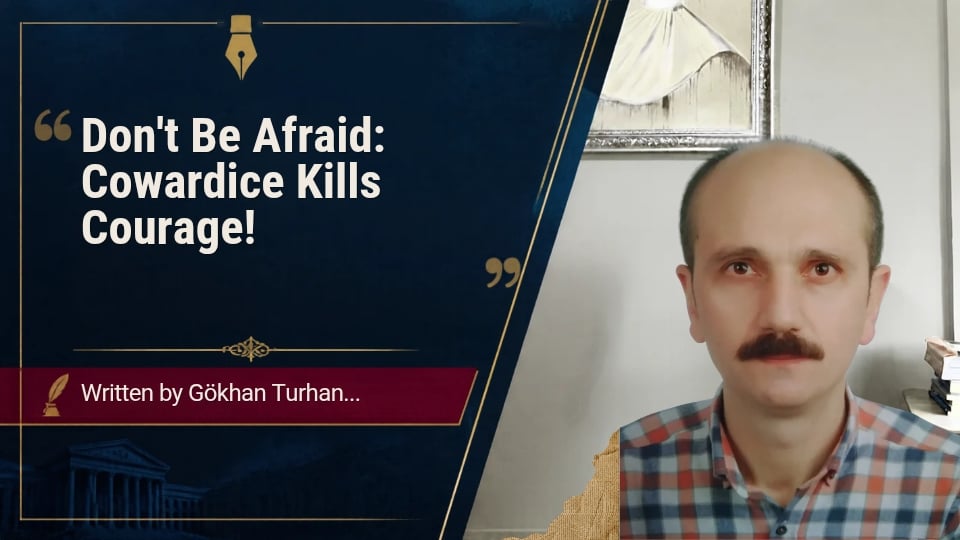
Don’t Be Afraid: Cowardice Kills Courage!
Gökhan Turhan