04 Ekim 2026
az bulutlu


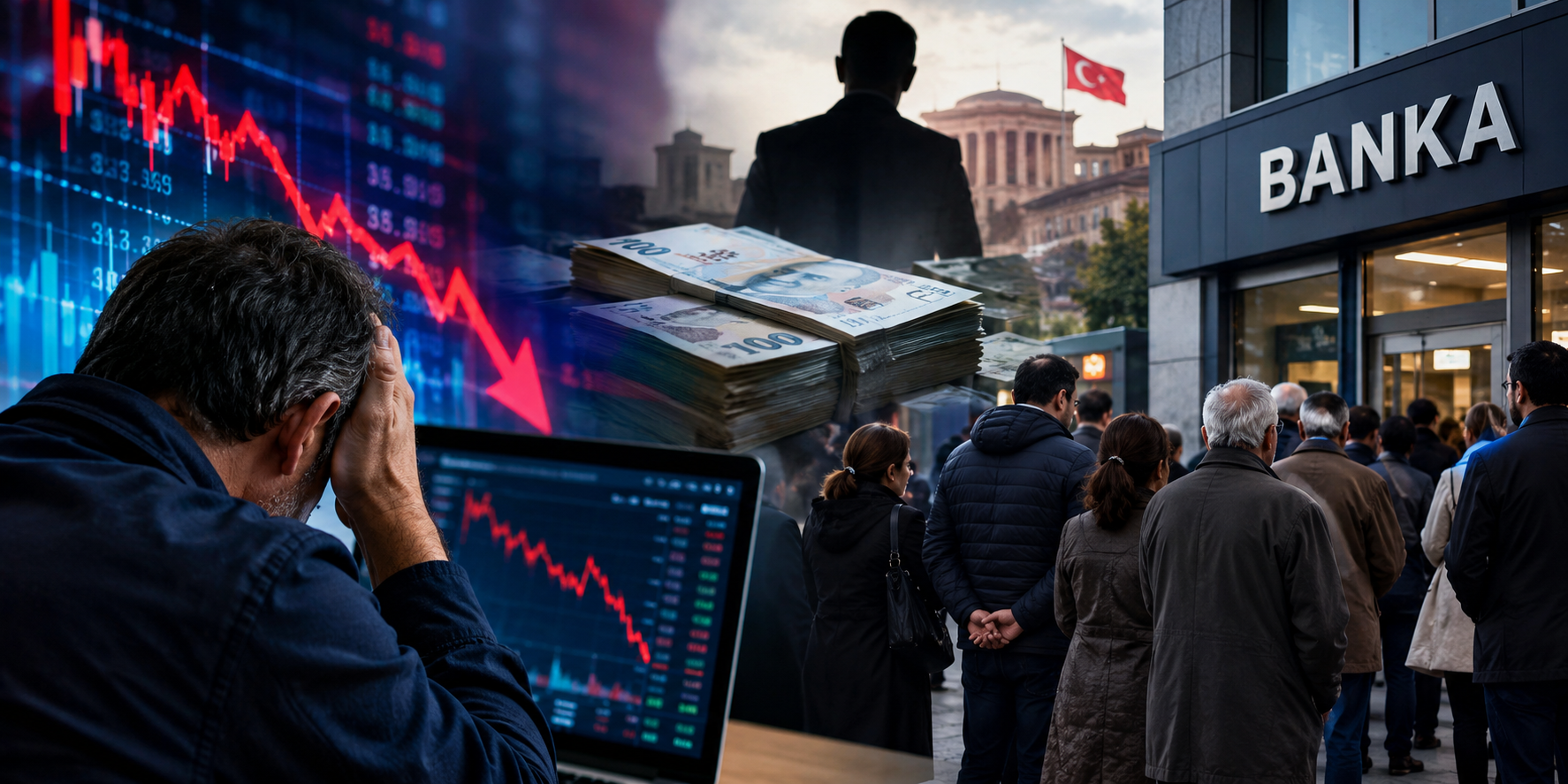
Turkey’s capital markets are experiencing one of their most serious shocks in recent years.
Behind the rhetoric of “protecting investors and expanding the stock market,” questions are mounting over how a fund pool reportedly worth $18.5 billion has turned into a story of disappearing wealth.
Hundreds of thousands of small investors are now left standing outside banks, trying to understand what happened to their savings.
But the issue can no longer be dismissed as merely a “stock market scam” or an ordinary fraud case.
The fact that allegations and investigation files reportedly extend into political circles, involve the children of former ministers, and raise questions about exits made with striking timing during the crisis has deepened concerns over fairness in the capital markets.
Periods when money loses value and inflation erodes savings make promises of easy profits even more attractive. At precisely such times, the gap between those who understand the weaknesses of the system and small investors becomes wider.
The alleged fund scandal that has shaken Turkey’s capital markets, reportedly involving a value of around $18.5 billion, is therefore no longer being viewed as merely a financial issue.
Because what is being lost here is not only money.
Trust is being lost as well.
Millions of small investors entered the market through public offerings, hoping to put their savings to work. Investors who trusted structures built around brokerage firms and portfolio management companies now find themselves facing profound uncertainty amid the crisis.
On one side are small investors watching their savings disappear.
On the other are individuals who are alleged to have managed to protect their money as the system began to collapse.
That is where the real question begins:
Were everyone really playing by the same rules?
Claims that certain individuals were able to exit funds immediately before the crisis emerged, or that billion-dollar sales were carried out in specific stocks, have become central to the public debate.
If such timing did in fact occur, every detail of how it was possible needs to be established.
Because in a market where even a few minutes can make a major difference for small investors, billion-dollar transactions carried out immediately before a crisis inevitably raise questions.
Fairness in capital markets does not depend solely on having rules written down. Those rules must be applied equally to everyone.
The “Voluntary Refund Accounts” formula introduced by the Capital Markets Board of Türkiye (SPK) for individuals reportedly generating excessive profits has also become a focal point of controversy.
Whatever the purpose of the measure may be, it is clear that public concerns have not disappeared.
On the contrary, debate has intensified over whether the mechanism could create the perception that wrongdoing is being covered up.
The fundamental issue is clear: If illicit gains were made, their source, method and responsible parties must be identified.
Once confidence in capital markets is damaged, rebuilding it is never easy.
If citizens begin to view the stock market not as an investment vehicle but as a “casino,” the economic consequences can be severe.
Because capital markets are built on more than money.
They depend on savings.
They depend on investment.
And above all, they depend on trust.
Statements from the government side such as, “Whether through stock market manipulation or corruption, anyone who reaches for the people’s rights will find us standing against them,” are therefore not enough on their own.
What the public wants to see is not another statement, but answers to all the questions.
The fact that political figures and their relatives have been mentioned in investigation files and allegations has pushed the debate far beyond the financial markets.
Unless claims involving travel bans, delayed judicial action and “privileged exits” are clarified, the questions surrounding the case will remain.
Because the question citizens are asking is actually very simple:
Is the law the same for everyone?
If certain people hold an advantage over others in the capital markets, then this is no longer merely a financial problem.
The very sense of justice is being damaged.
What is happening today is not simply a matter of billions of dollars that are reportedly missing.
The deeper issue is the erosion of people’s trust in the savings they have accumulated over years.
When citizens put their money into a bank, fund or stock market, they expect to be able to trust the rules governing the system.
Even the perception that people with inside information, political connections, or alleged advance knowledge of the crisis were able to gain an advantage is enough to destroy that trust.
While small investors sit in front of their screens wondering, “What will happen to my money tonight?”, the belief that others may have protected their fortunes by exploiting weaknesses in the system cannot simply be accepted.
The future of the capital markets will not be determined by new regulations alone.
The real test will be whether the sense of justice can be restored.
Because the foundation of capital markets is trust before money.
Without trust, there is no investment.
Without justice, there is no trust.
And once that trust is destroyed, what remains is not merely the reported wreckage of $18.5 billion, but a far heavier social cost.